Key Takeaways: Ketamine Therapy NYC
- Nearly 30% of patients with MDD are considered treatment-resistant, meaning two or more antidepressant trials have failed
- IV ketamine delivers 100% bioavailability directly into the bloodstream, versus only 17–24% for sublingual at-home lozenges
- Research in ScienceDirect highlighted significant antidepressant effects can appear within 4 to 24 hours of the first infusion
- Clinical supervision at Ketamine Wellness NY includes real-time monitoring of blood pressure and heart rate during every session
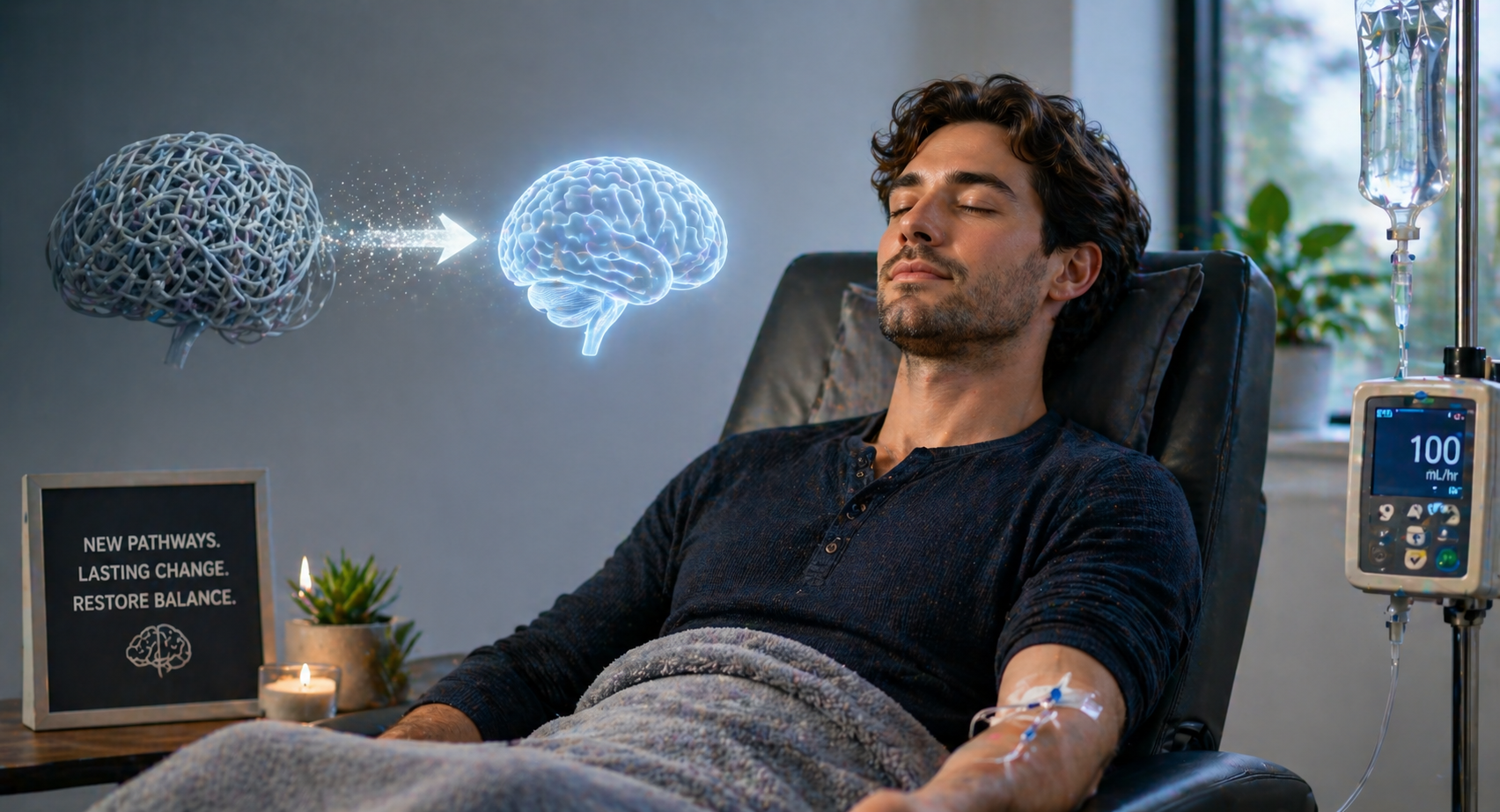
- Ketamine opens a window of neuroplasticity, making ongoing talk therapy and lifestyle integration significantly more effective after treatment
When Standard Antidepressants Stop Working
Most people try SSRIs with real hope. They follow instructions, wait six to eight weeks, adjust the dose, and switch to a second option. Then a third.
Treatment-Resistant Depression (TRD) is the clinical term for what happens when at least two antidepressant trials fail to produce meaningful relief. It affects nearly one-third (30%) of patients with Major Depressive Disorder (MDD). That is not a small number.
What “Treatment-Resistant” Actually Means
TRD is not a personal failure. It reflects a biological gap.
Standard SSRIs target the serotonin system. For many patients, serotonin regulation is not the primary driver of their depression. When the mechanism does not match the condition, the medication does not work, no matter how long you wait.
IV ketamine targets the glutamate system, a fundamentally different neurological pathway. So, patients who have failed multiple antidepressants often respond to ketamine when nothing else has. The approach is different at the root level, not just in dosage or delivery.
The financial and personal cost of staying in this cycle is significant. Lost productivity, strained relationships, years of side effects that trade one problem for another. For many, ketamine therapy is not a first choice, it is a decision made after exhausting everything else.
Sarah’s Story: Seven Years of The Wrong Medications
Treatment-resistant depression. Two letters of recommendation from her psychiatrist. A drawer full of orange prescription bottles that didn’t work.
Sarah is 34, a marketing director in Queens. She started Zoloft at 27, switched to Lexapro at 29, added Wellbutrin at 31. Each medication offered something, a blunted edge, a few better weeks, but none restored the baseline she remembered from before depression arrived.
What The Medications Did, and Didn’t Do
The side effects became part of the problem. Weight gain. Persistent cognitive fog. A flattened emotional range that made her feel present at work but absent everywhere else.
She researched at-home ketamine therapy because the convenience appealed to her schedule. When she understood the bioavailability difference, she changed course:
- At-home sublingual lozenges: 10–30% of the dose reaches the brain after first-pass metabolism
- IV ketamine infusion: 100% bioavailability, zero digestive processing
- Clinical monitoring: Blood pressure and heart rate tracked in real time throughout the session
“I didn’t want to do a medical treatment at home without a doctor in the room. That felt like a shortcut I couldn’t afford to take.”
What Changed After IV Ketamine Therapy
After her third infusion at Ketamine Wellness New York, Sarah noticed something specific, not euphoria, not a dramatic shift. A quiet stability she had not felt in years.
By session four, she could plan her week without dreading it. She went to the grocery store without having to talk herself into it. Small wins. Measurable ones.
She continues with periodic maintenance infusions and remains in therapy. “I still have hard days,” she said. “But I have a baseline now. That is new.”
Mark’s Story: PTSD In An NYC First Responder
The weight doesn’t announce itself. It builds quietly across years of calls, scenes, and things that cannot be unseen.
Mark is an NYC first responder who developed PTSD after years on the job. Hypervigilance, intrusive thoughts, and a nervous system running on high alert. Standard antidepressants and cognitive-behavioral therapy helped at the margins. They did not quiet the core.
Why Traditional Therapy Wasn’t Enough
Research in the American Journal of Industrial Medicine on NYC firefighters following the September 11 attacks documented persistent, high rates of PTSD across years of follow-up.
The data reflects what many first responders know privately: standard treatment protocols often fall short for trauma at this depth.
Mark’s challenge was specific. His nervous system stayed in threat-response mode even during therapy sessions. The talk therapy could not land because his brain was always already defending.
Ketamine does not treat the trauma directly. It reduces the neurological reactivity enough for therapy to take hold.
This is what researchers describe as the neuroplasticity window, a period of heightened neural flexibility following ketamine infusion where new patterns can form.
How The Clinical Setting Made The Difference
Mark had real concerns about dissociation during infusion. He wanted control, not a loosening of it.
The team at Ketamine Wellness New York explained the real-time monitoring protocol before his first session. Vital signs tracked throughout. Dosage adjustable mid-infusion. A clinical team physically present, not on a telehealth screen.
“Having someone actually in the room mattered more than I expected. For someone with PTSD, that safety isn’t optional.”
His results were not instant. Over a series of infusions paired with trauma-focused therapy, Mark noticed a gradual decrease in the reactivity that had made therapy impossible.
“Ketamine therapy near me” was a search he almost never made. The clinic in Jackson Heights was just 20 minutes from his station. He was skeptical that it was real medicine. He’s much less skeptical now.
Elena’s Story: High-Functioning, Quietly Unraveling
She showed up to every meeting. She managed every deadline. No one knew.
Elena is a legal professional in Manhattan and a mother of two. From the outside, her life looked fine. Inside, she was white-knuckling every day through comorbid anxiety and depression that no medication had touched consistently.
She had tried at-home ketamine therapy first. The appeal was clear: no clinic appointments, no time off work, treatment at home. The results were not what she hoped.
Why At-Home Ketamine Therapy Produced Inconsistent Results
Elena’s experience mirrors what the clinical literature shows. Sublingual lozenges produce variable absorption. On some sessions, she felt something. On others, nothing meaningful happened.
There was no one to adjust the dose in real time. No physician reading her vitals. No ability to respond when the experience felt unsettling rather than therapeutic.
She switched to IV ketamine therapy specifically because she needed precision. At Ketamine Wellness NY, Dr. Pervaiz Qureshi, board-certified in internal medicine and Ketamine Wellness NY’s medical director, adjusts the protocol to each patient’s body profile.
The IV drip allows micro-adjustments that a fixed-dose lozenge cannot replicate.
What Clinical IV Ketamine Therapy Changed
The shift was not dramatic on the first infusion. By the third, Elena described a clarity she had not associated with her own mind before.
“I could sit with my kids at dinner without mentally running through tomorrow’s case file. That sounds small. It was not small.”
She continues therapy alongside maintenance infusions. She does not describe herself as cured. She describes herself as present, which, for her, is the actual goal.
IV Ketamine Therapy Vs. At-Home Alternatives: What The Data Shows
The comparison comes up constantly. At-home lozenges cost less. The scheduling is easier. The marketing is compelling.
Here is what the clinical picture looks like side by side:
Comparison of IV Ketamine at Ketamine Wellness NY, At-Home Lozenges, Spravato Nasal Spray, and Standard SSRIs | Feature | Ketamine Wellness NY – IV Ketamine Therapy | At-Home Lozenges (e.g., Mindbloom) | Nasal Spray (Spravato) | Standard SSRIs |
| Bioavailability | 100% (Direct to bloodstream) | 10–30% (Variable) | 45–50% | N/A |
| Medical Supervision | 1:1 In-Person Clinical Monitoring | Remote / Solo at home | In-Office (Limited) | None |
| Dosing Precision | Micro-Adjusted in Real-Time | Fixed Oral Dose | Fixed Dose | Fixed Oral Dose |
| Safety Monitoring | Vital Signs Tracked Throughout | Self-Monitored | Limited BP Checks | None |
| Speed of Relief | 4 to 24 Hours | Weeks | Days to Weeks | 4 to 8 Weeks |
| Session Format | 40–60 min, clinical setting | 60–90 min, home | 2-hour observation | Daily, ongoing |
| Best For | TRD / PTSD / High-Intensity Comorbidity | Mild symptoms / convenience | Insured MDD patients | Mild-to-moderate depression |
For patients with insurance coverage, Spravato (esketamine nasal spray) may be a covered in-office alternative worth discussing with your provider, Ketamine Wellness NY’s clinical team can help you evaluate whether IV ketamine or Spravato is the better fit for your situation.
Takeaway: IV therapy delivers more medicine to your brain, with a doctor present, in a setting designed for the process. That combination is not a luxury, it is the clinical standard for complex cases.
Bioavailability (100% Vs. 30%)
When you take a ketamine lozenge, your digestive system and liver process the medication before it reaches your brain. This first-pass metabolism degrades a significant portion of the dose.
A 2022 study in Frontiers in Psychiatry shows sublingual ketamine reaches the brain at only 10–30% of the administered amount.
IV infusion bypasses this entirely. The medication enters the bloodstream directly. The physician controls concentration in real time. If a patient’s response changes mid-session, the drip rate adjusts immediately.
For patients managing treatment-resistant depression or PTSD, this precision is not a minor advantage. It is the mechanism that makes the treatment work.
Clinical Setting Vs. Living Room Safety
Ketamine raises blood pressure and heart rate temporarily during infusion. In a clinical environment, trained staff monitor these vitals throughout the session and respond if values change unexpectedly.
At home, there is no one to respond.
Beyond the physical safety factor, the psychological safety of a professional clinical environment matters for outcome quality. Trauma patients, in particular, need a stable, monitored setting to allow the dissociative process to be therapeutic rather than destabilizing.
What These Three Stories Have In Common
Sarah, Mark, and Elena came from different backgrounds, different diagnoses, and different paths to Ketamine Wellness New York. Their shared experience reveals the honest picture of what ketamine therapy in NYC actually does.
- None of them experienced a dramatic, instant, and reliable cure
- All of them had exhausted at least two other treatment options first
- All of them continued therapy or lifestyle support alongside infusions
- All of them found that ketamine restored their capacity to engage
Ketamine is not a replacement for therapy. It is the tool that makes therapy work again when the brain’s default neurochemistry has made that impossible.
Is Ketamine Therapy In NYC Right For You?
This is not a treatment for everyone. That is worth saying clearly.
Ketamine therapy at Ketamine Wellness NY is most effective for patients who meet specific clinical criteria. These primarily include treatment-resistant depression, PTSD, or anxiety that has not responded adequately to standard interventions.
A consultation with the clinical team at Ketamine Wellness New York is the appropriate first step. Dr. Qureshi and the medical team review your history, current medications, and symptom profile before recommending a protocol. This is a medical decision, not a scheduling one.
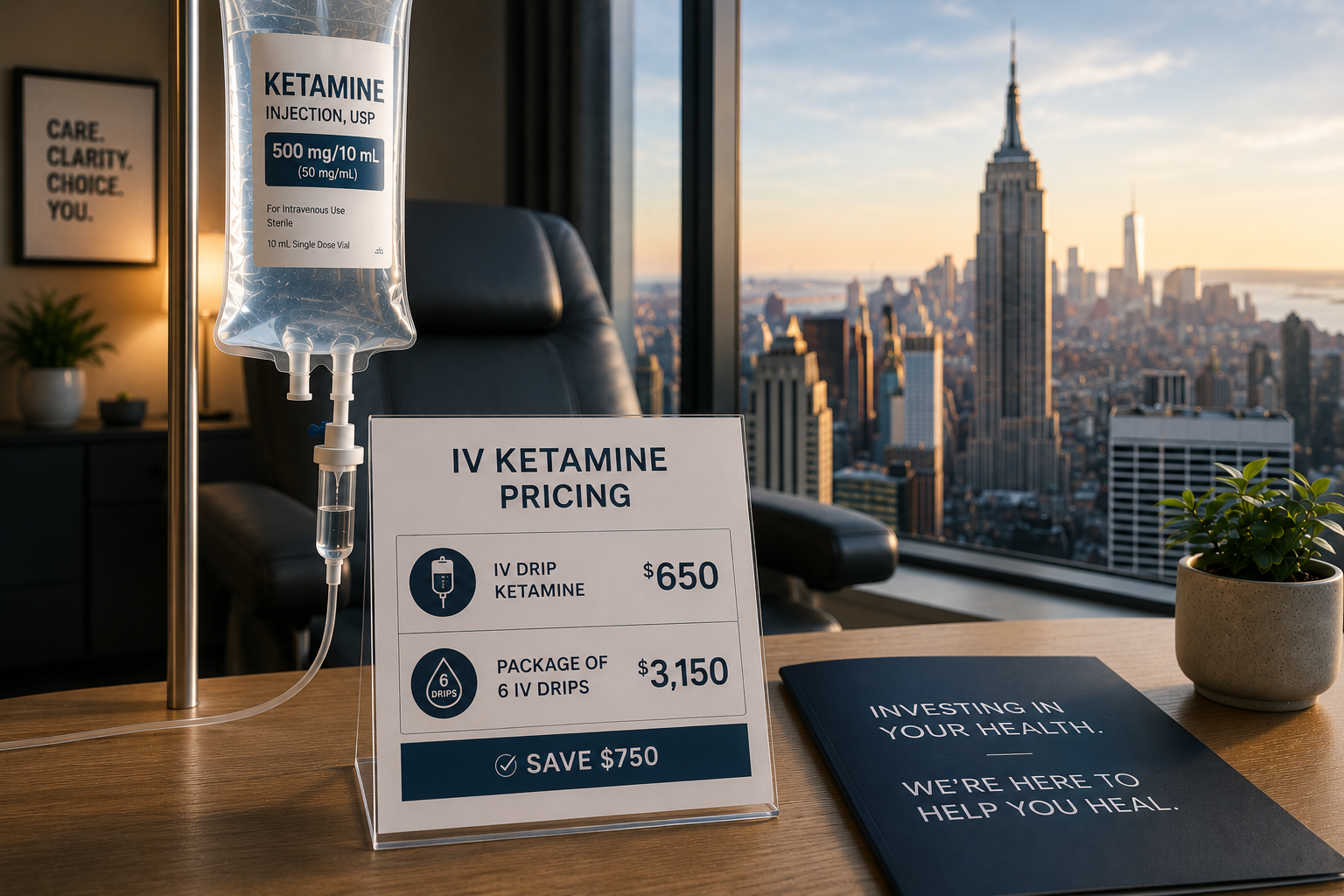
At Ketamine Wellness NY, IV ketamine therapy starts at $550 for an introductory session, $650 for a standard single session, with a six-session package at $3,250.
IV ketamine is typically cash-pay; superbills available for out-of-network reimbursement. Read our guide on, is ketamine therapy covered by insurance in New York, to know how much you’re going to pay.
If you have been through two or more antidepressant trials without adequate relief, a clinical evaluation will tell you whether IV infusion is the right next step. This is especially important if you have tried at-home ketamine therapy and found the results inconsistent.
Frequently Asked Questions (FAQs)
What makes IV ketamine better than at-home lozenges?
IV therapy provides 100% bioavailability, meaning your brain receives the full dose immediately. At-home lozenges are subject to first-pass metabolism, which reduces effectiveness to roughly 10–30%, often leading to inconsistent results.
How soon will I know if ketamine therapy is working?
One of the most significant benefits of IV ketamine is its rapid onset. Many patients at Ketamine Wellness New York report a noticeable shift in their mood or a reduction in suicidal ideation within 4 to 24 hours after their first or second infusion.
Is ketamine therapy in NYC safe for first responders with PTSD?
Yes. Ketamine therapy is often highly effective for first responders because it addresses neurological patterns underlying PTSD. Clinical monitoring of blood pressure and heart rate ensures safety throughout each session.
How much does ketamine therapy cost in NYC?
The cost of a single IV ketamine infusion in 2026 typically falls between $400 and $800. At Ketamine Wellness NY, IV ketamine therapy starts at $550 for an introductory session and $650 for a standard single session. A six-session induction package is available at $3,250.
Where in New York City is Ketamine Wellness NY located?
Ketamine Wellness New York has two clinic locations: Jackson Heights in Queens and Great Neck on Long Island. Both offer the same IV ketamine infusion protocol under direct physician supervision. You can find directions and contact information on our locations page.
How many sessions of ketamine therapy do I need?
Most patients begin with a six-session induction series. Some experience meaningful relief after two or three infusions. Your exact protocol depends on diagnosis, symptom severity, and your response to early sessions, Dr. Qureshi’s team determines this during your initial consultation.
Conclusion: Ketamine Therapy NYC
Standard treatments fail a significant portion of patients. That is not a personal outcome, it is a documented clinical reality.
For those patients, ketamine therapy in New York represents a different mechanism, a faster onset, and a clinical setting designed to support safe, effective treatment.
The three stories here are not exceptional outcomes. They are what carefully supervised IV ketamine therapy produces for patients who meet the criteria.
If the medication merry-go-round has been your experience, a consultation is worth the conversation. You can also visit us at our NYC or Queens clinic.
 Skip to content