



You have tried several antidepressants, and therapy helps a little. Still, the heaviness has not fully lifted for you. Now you are reading about IV ketamine, and one question keeps returning. How do you raise it without sounding like you want a shortcut?
This guide explains how to talk to your doctor abo ut ketamine therapy, step by step. You will learn what to prepare, which phrases help, and what to do if your doctor hesitates. We also explain what happens next if you choose ketamine therapy on Long Island.
Questions about your own care are completely normal. A prepared conversation is usually a calmer one. Many readers feel nervous about this step, and that is common. Your doctor wants a safe plan, and so do you.
Why You Should Talk To Your Doctor About Ketamine Therapy First
Before you learn how to talk to your doctor about ketamine therapy, it helps to know why that step matters. Here we cover safety, regulation, and how ketamine and antidepressants together fit into one plan.
Ketamine works best inside a care plan, not around one. Your doctor knows your history, your medications, and how your depression has responded over time. That includes whether ketamine and antidepressants together are safe for you.
Ketamine is FDA-approved as an anesthetic, but not for any psychiatric condition. That makes its use for depression an off-label choice. The FDA also warns about the risks of unmonitored ketamine use.
Most research on IV ketamine focuses on treatment-resistant depression. That means depression that has not improved after adequate trials of standard antidepressants. Murrough et al. (2013) reported rapid antidepressant effects from IV ketamine in treatment-resistant depression.
If you are having thoughts of suicide, call or text 988 now, or call 911 if you are in immediate danger. Then let your doctor know as soon as you can.
Continued contact with your care team also protects you. Many people keep seeing their psychiatrist or therapist during treatment.
Who To Talk To About Ketamine Therapy
The right person depends on who manages your care today. This section covers your psychiatrist, primary care physician, and therapist. If you worry about sounding pushy, the sample phrases below can help.
- Your psychiatrist is usually the best first stop. They manage your antidepressants and know your diagnosis history.
- Your primary care physician is a good start if you have no psychiatrist. They can review your blood pressure and heart health, then refer you to a mental health specialist.
- Your therapist cannot prescribe medication, but can help you think through the decision. With your permission, they can also share observations with your other clinicians.
Whoever you choose, book a longer visit if you can. A dedicated appointment gives you room to ask every question.
Before Your Appointment: What to Prepare
Preparation turns a rushed visit into a useful one. Bring more detail than you think you need.
The National Institute of Mental Health advises writing down your questions, listing every medication and supplement, and reviewing family history. For a ketamine conversation, your treatment history matters most.
Our guide on when antidepressants stop working can help you describe your own history. Copy this treatment history worksheet and fill it in before your visit.
| Treatment | Dose and How Long | What Happened |
|---|---|---|
| Antidepressant 1 | Name, highest dose, number of weeks or months | Helped, helped a little, no change, or side effects |
| Antidepressant 2 | Name, highest dose, number of weeks or months | Helped, helped a little, no change, or side effects |
| Add-on medications | Name, dose, how long | What changed |
| Therapy | Type (for example CBT), how often, how long | What helped and what did not |
| Other treatments | For example TMS, ECT, or Spravato | Outcome |
Also Bring:
- A complete list of current medications, supplements, and over-the-counter products
- Medical conditions, especially high blood pressure, heart or lung problems, or substance use history
- Whether you are pregnant, breastfeeding, or planning a pregnancy
- A few lines on how depression affects your work and relationships
- What you hope treatment will change in daily life
If it helps, bring a trusted friend or family member. They can take notes and share how you have seemed lately.

A Common Scenario
A patient arrives with a one-page treatment history and three written questions. Her psychiatrist, new to ketamine, asks to keep a copy. They agree to review safety together at a follow-up visit.
How To Talk To Your Doctor About Ketamine Therapy? Sample Phrases
There is no perfect script, but direct and specific wording usually works best. These sample phrases are suggestions in your own voice, so adapt them freely to fit your situation.
How do you talk to your doctor about ketamine therapy? Share your treatment history, say what you hope to change, and ask for your doctor's opinion on safety and fit. Ask questions instead of making requests, and agree on a follow-up if more review is needed.
- "I have tried several treatments for my depression, and I still do not feel well. I have been reading about IV ketamine for treatment-resistant depression. I would like your opinion on whether it fits me."
- "I am not asking you to change anything today. I want to understand whether ketamine is safe with my medications and health."
- "If ketamine is not right for me, can you explain why and what we should try next?"
If you feel nervous, say so out loud. Doctors hear questions about new treatments often, and asking about your options is a normal part of care.
Questions To Ask About Ketamine Therapy At Your Appointment
Written questions keep the visit focused and help you remember the answers afterward. Here are the questions to ask about ketamine therapy, grouped around safety, side effects, fit, and coordination.
- Does my depression fit the description of treatment-resistant depression?
- Is anything in my medical history a reason ketamine might be unsafe for me?
- Would any current medication need review, and who should make those decisions?
- What are the common side effects, and how would we handle them?
- How would ketamine fit with my current treatment, and would I keep seeing you?
- What other options should we consider, and how do they compare for me?
- Would you be willing to coordinate with the clinic that provides infusions?
Write the answers down, or ask your companion to do it.
Medical Factors Your Doctor Will Want To Review
Safety screening comes first, and every clinic sets criteria. This section covers medical exclusions and the common question about medications to stop before ketamine. The short answer is that you should not stop anything alone.
An academic medical center's patient guide lists examples of conditions that can rule out ketamine or need extra clearance. Examples include:
- Uncontrolled high blood pressure
- Pregnancy
- Recent mania or psychosis
- Active substance use disorder
- A history of ketamine misuse
That guide also names medications your doctors may want to review. Examples include lamotrigine, benzodiazepines, stimulants, bupropion, opioids, and other sedating drugs. Some may interact with ketamine or add to sedation.
Do not stop or change any medication on your own. Abrupt changes to some of these medications can be dangerous. Any change should be planned by the doctor who prescribes it.
Our guide on who is not a good candidate for ketamine covers eligibility in more detail.
If Your Doctor Is Hesitant: What To Do When "My Doctor Won't Prescribe Ketamine"
A cautious reply is not a closed door. It is common to feel discouraged after a visit like this. This section covers what to do and what to try next.
Start by asking what concerns your doctor has. They may relate to your blood pressure, your history, or limited experience with ketamine. Concerns you understand are concerns you can address together.
Your doctor may suggest other options for treatment-resistant depression. These include different medications, TMS, ECT, or Spravato. Spravato is an FDA-approved esketamine nasal spray given at certified treatment centers.
Each of these is a legitimate option worth discussing with your doctor. Our article on ketamine and esketamine explains how the two differ.
If you still want another view, NIMH notes that seeking another opinion is reasonable. A second opinion is not disloyal, and it is part of good care.
What Happens Next At Our Long Island Clinic
After you speak with your doctor, the next step may be a clinical intake. If you decide to explore treatment on Long Island, here is what to expect.
Ketamine Wellness New York provides physician-supervised IV ketamine at our Long Island clinic in Great Neck. The clinic sits at 45 Middle Neck Road, Suite 220, a five-minute walk from the Great Neck LIRR station. Our second clinic is in Jackson Heights (Queens).
Care is led by Dr. Pervaiz Qureshi, MD, board-certified in internal medicine. He completed his internal medicine residency at Brooklyn Hospital Center and has more than 30 years of clinical practice, and that medical background matters here. Your blood pressure, medications, and overall health all shape a safe plan.
- Your intake reviews your mental health history, current medications, and goals.
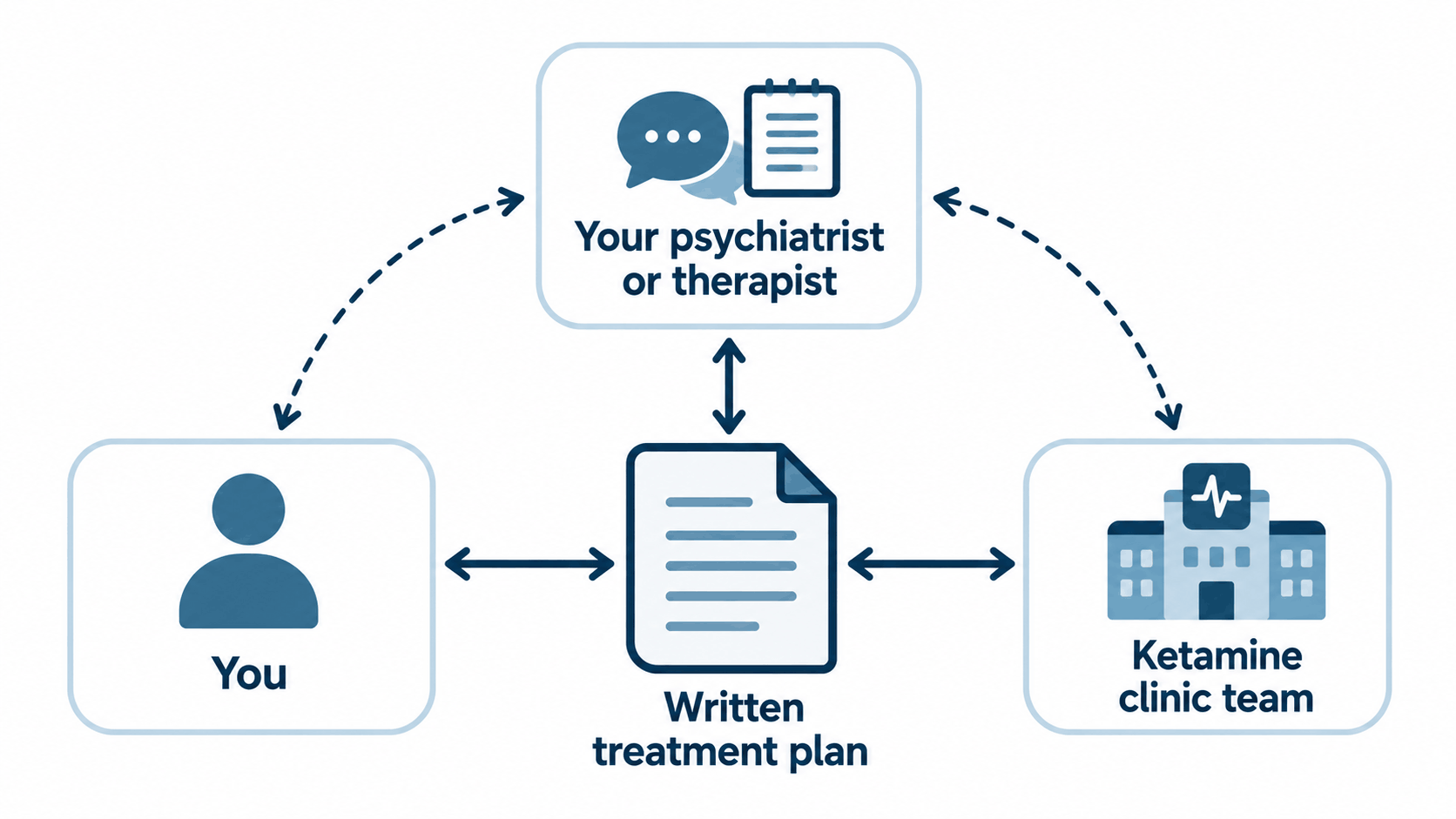
- Your written treatment plan covers coordination with any psychiatrist or therapist you already see.
- Infusions last 40 to 90 minutes with continuous nurse monitoring, then 30 to 60 minutes of recovery.
- You will need someone else to drive you home afterward.
- The recommended series is six infusions over two to three weeks.
Our guide to what to expect during an infusion walks through each step. Our overview of IV ketamine for depression explains the treatment itself.
We are cash-pay, accept HSA and FSA cards, and do not bill insurance directly. Current prices are listed on our pricing page.
Frequently Asked Questions (FAQs)
Do I need a referral for ketamine therapy on Long Island?
Requirements vary by clinic, so ask before you book. Even when a referral is not required, your treatment history and medication list make intake safer and faster. Call our Great Neck clinic at (516) 203-1041 to ask what to bring.
Should I stop my antidepressant before starting ketamine?
No, please do not stop it on your own. Some medications may need review before treatment, and your prescriber should lead that decision. Sudden changes to certain drugs can be harmful, so ask first.
Will my doctor think I am drug-seeking if I ask about ketamine?
A thoughtful question about a studied treatment is not drug-seeking. Bring your treatment history, explain what you have tried, and ask for your doctor's opinion. That shows you want a safe, supervised plan.
Can I keep my psychiatrist or therapist during ketamine treatment?
Yes, and we encourage you to stay connected with them. At Ketamine Wellness NY, your written treatment plan covers coordination with any psychiatrist or therapist you already see. Ketamine is meant to support your existing care, not replace it.
How much does ketamine therapy cost on Long Island?
Ketamine Wellness NY is cash-pay and also accepts HSA and FSA cards. We do not bill insurance directly, so plan for that when budgeting. Current pricing is listed on our pricing page.
Where is Ketamine Wellness NY located?
We have two clinics: Great Neck (Long Island) and Jackson Heights (Queens). The Great Neck clinic is at 45 Middle Neck Road, Suite 220. Call (516) 203-1041 if you have questions before booking.
Bring This Guide To Your Next Appointment
Bring this guide and your treatment history to both appointments, so everyone works from the same information. If you have questions about IV ketamine, call (516) 203-1041 or book a consultation.
Our clinics are in Great Neck (Long Island) and Jackson Heights (Queens). We do not have a Manhattan location. If you are in crisis, call or text 988 at any time.
Our list of Long Island mental health resources offers more support options.
Final Thoughts
How to talk to your doctor about ketamine therapy comes down to preparation, honesty, and patience. A clear treatment history, a few good questions, and a calm tone go a long way.
Your doctor may need time to think, and that is okay. You have already done something brave by looking for answers. Keep your care team close, ask your questions, and move forward at a pace that feels safe.
Resources
- FDA: Potential Risks Associated With Compounded Ketamine Products
https://web.archive.org/web/20260530025451/https://www.fda.gov/drugs/human-drug-compounding/fda-warns-patients-and-health-care-providers-about-potential-risks-associated-compounded-ketamine - Murrough, et al. (2013). Antidepressant Efficacy of Ketamine in Treatment-Resistant Major Depression: A Two-Site Randomized Controlled Trial
https://psychiatryonline.org/doi/10.1176/appi.ajp.2013.13030392 - Grunebaum, et al. (2017). Ketamine for Rapid Reduction of Suicidal Thoughts in Major Depression: A Midazolam-Controlled Randomized Clinical Trial
https://psychiatryonline.org/doi/10.1176/appi.ajp.2017.17060647 - NIMH: Tips for Talking With Your Health Care Provider
https://www.nimh.nih.gov/health/publications/tips-for-talking-with-your-health-care-provider - Northwestern Medicine (academic medical center): Ketamine Treatment Patient Guide
https://www.nm.org/-/media/northwestern/resources/patients-and-visitors/patient-education/medication/northwestern-medicine-ketamine-treatment.pdf