
You read one article, then another, and the names keep blending together. Ketamine, esketamine, Spravato: are they the same thing or not? That confusion is understandable, especially when you are already tired from living with depression.
Here, we explain the ketamine therapy vs. esketamine Spravato differences in plain language. We cover the compounds, the FDA status, and how each treatment is actually given.
At Ketamine Wellness New York, we provide IV ketamine therapy only, and we say so up front. That way, you can read this as a fair comparison, not a sales pitch. Questions like “which is better?” deserve careful answers, not shortcuts.
Our goal is simple: you leave knowing what separates these two options. That clarity makes your next conversation with a provider far easier. Let’s start with what each treatment actually is.
Ketamine and esketamine are close relatives, but they are not identical products. This section explains how the molecules relate and where the practical differences begin, so the rest of the comparison makes sense.
Spravato is not the same as ketamine. Spravato is a brand-name nasal spray whose active ingredient is esketamine, the S-form of ketamine. IV ketamine contains both mirror-image forms. The two are closely related, but they are separate products with different approvals and delivery methods.
Why does the mix-up happen? News stories and forums often use the names as if they mean one thing.
They are related, yet each has its own evidence, label, and rules. Esketamine is a refined, separately studied product, not a simple stand-in for infusion therapy. That distinction matters when you compare costs, safety rules, and what a session looks like.
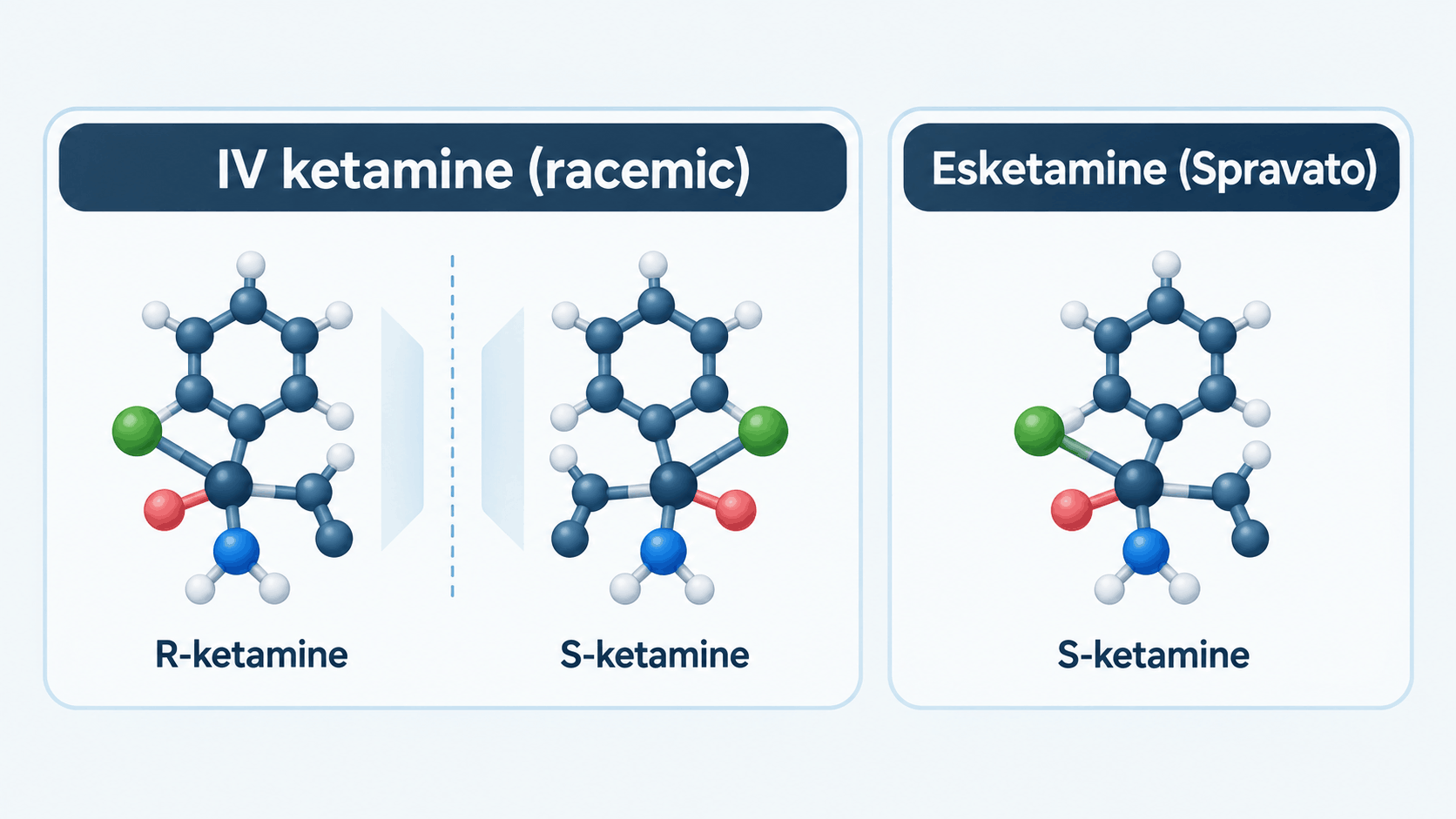
The difference between ketamine and Spravato starts at the molecular level. Ketamine is a racemic mixture, which means it contains two mirror-image molecules called R-ketamine and S-ketamine.
Esketamine isolates the S-form and is sold as its own branded medication. Both compounds are thought to act on NMDA receptors and downstream neuroplasticity pathways. Researchers are still studying exactly how that produces an antidepressant effect.
Similar pathways do not make the products interchangeable. Formulation, route, and regulation all shape how each one is used. That is why a clinician cannot simply swap one for the other. Dose, timing, and monitoring all follow separate rules.
Approval status is where many online articles slip into imprecise claims. Here, we keep the facts exact and explain what a regulatory label does and does not tell you about effectiveness.
The FDA approved Spravato in March 2019 for adults with treatment-resistant depression. At first, it had to be used alongside an oral antidepressant.
In January 2025, the FDA expanded the label so Spravato can also be used on its own. A separate FDA indication covers depressive symptoms in adults with major depressive disorder with acute suicidal ideation or behavior, used with an oral antidepressant.
Spravato is available only through a certified healthcare setting under a REMS (Risk Evaluation and Mitigation Strategy) program. You cannot take it home, and staff observe you after every dose.
Why does that matter? It shapes scheduling, supervision, and insurance conversations. That structure is one reason approval status and treatment experience are linked.
IV ketamine is FDA-approved as an anesthetic, a use dating back decades. Its use for depression is off-label, meaning physicians prescribe an approved medication for a different indication. Off-label prescribing is legal and common across medicine.
Why no formal approval? Drug approval usually follows a manufacturer’s costly, product-specific pathway. Generic ketamine has less commercial incentive for that route.
Still, research supports its use: Marcantoni et al (2020) pooled trials of IV ketamine in treatment-resistant depression. Sanacora et al (2017) outlined consensus guidance on ketamine for mood disorders in JAMA Psychiatry.
Neither approval status is a verdict on which treatment works better. It reflects each product’s regulatory path, not a head-to-head ranking.
Many articles claim one treatment simply works better. The evidence does not support a blanket ranking.
At the 2026 annual meeting of the American Society of Clinical Psychopharmacology (ASCP), a retrospective review of health records comparing both treatments was presented. Records like these show associations, and they cannot prove that one treatment caused a difference.
A multi-site randomized trial from Yale researchers will compare the two, but results are several years away.
Research on suicidal ideation also exists for ketamine, including work by Wilkinson et al. (2017). Each source is useful, yet none settles the question alone. The honest answer is that your history and goals shape the better fit.
The two treatments feel quite different once you are actually in the chair. This section covers how each is delivered, who adjusts the dose, and how long you stay.

An IV ketamine infusion delivers medication directly into your bloodstream through a small catheter. Dr. Pervaiz Qureshi, MD, board-certified in internal medicine, reviews each patient’s history before an infusion plan begins.
In most published research, the dose is 0.5 mg/kg infused over about 40 minutes; at Ketamine Wellness New York, infusions run 40 to 90 minutes depending on your protocol. Because the medication enters the bloodstream directly, a clinician can adjust the rate in real time.
A Common Scenario
A patient finds the first ten minutes of an infusion too intense. The clinician slows the rate and checks in, and the patient continues comfortably.
Many patients begin with an induction series of six infusions over two to three weeks. Maintenance sessions typically follow at intervals of one to three months.
Spravato nasal spray follows a standardized dosing protocol set by its FDA-approved label. You self-administer the spray, but only under direct observation in a certified setting.
Staff monitor you for at least two hours after each dose under REMS requirements. The dose does not change mid-session the way an infusion rate can.
In a Spravato nasal spray vs ketamine infusion comparison, the biggest practical gap is dose flexibility. The FDA prescribing label reports nasal bioavailability of about 48%, while IV delivery reaches the bloodstream directly.
Your prescriber follows the label’s schedule, which keeps the structure consistent. Both treatments involve real supervised time at the point of care.
This table places IV ketamine vs Spravato side by side, so you can scan the key facts quickly. Each row reflects what we covered above, with no claim about which option is better.
| IV Ketamine | Spravato (Esketamine) | |
|---|---|---|
| Compound | Racemic ketamine (R- and S-forms) | Esketamine (S-form only) |
| FDA status | FDA-approved as an anesthetic; off-label for depression | FDA-approved for treatment-resistant depression (2019) and depression with acute suicidal ideation or behavior |
| Delivery | IV infusion given by clinical staff | Nasal spray, self-administered under observation |
| Dosing | Adjustable by a clinician in real time (mood protocols typically 0.5 mg/kg over about 40 minutes) | Standardized dosing set by the FDA label |
| Regulatory framework | Off-label physician prescribing | FDA REMS program with mandatory in-office observation |
| Monitoring | Throughout the infusion and recovery | At least two hours after each dose |
| Cost pattern | Typically paid out-of-pocket ($550 introductory session at Ketamine Wellness NY) | More commonly covered by insurance, depending on your plan |
| Offered at Ketamine Wellness NY | Yes, at Jackson Heights (Queens) and Great Neck (Long Island) | No, we do not offer, administer, or refer for Spravato |
Takeaway: They are related but separate treatments, and your history and provider guidance decide the fit.
No blog post can choose a treatment for you, and we will not try. We can, however, describe the common patterns that patients and providers often talk through together in a consultation.
No universal answer exists, because both treatments have clinical research behind them. The better fit depends on your diagnosis, prior treatments, and provider guidance.
Some patients tried Spravato first, often because insurance covered it, and later explored IV ketamine after limited relief. Others are hearing about both options for the first time.
Preference around nasal spray versus infusion also matters. Your response to past medications, your schedule, and your comfort with each setting all count.
Neither path makes one treatment the right choice for everyone. Treat these points as conversation starters, not as rules. A thoughtful provider will walk through all of these with you.
Insurance often shapes real decisions more than any efficacy comparison. Spravato’s FDA approval means it is more commonly covered by insurance, depending on the plan.
IV ketamine for depression is off-label, so it is typically paid out-of-pocket. You can read more about whether ketamine is covered by insurance in our guide.
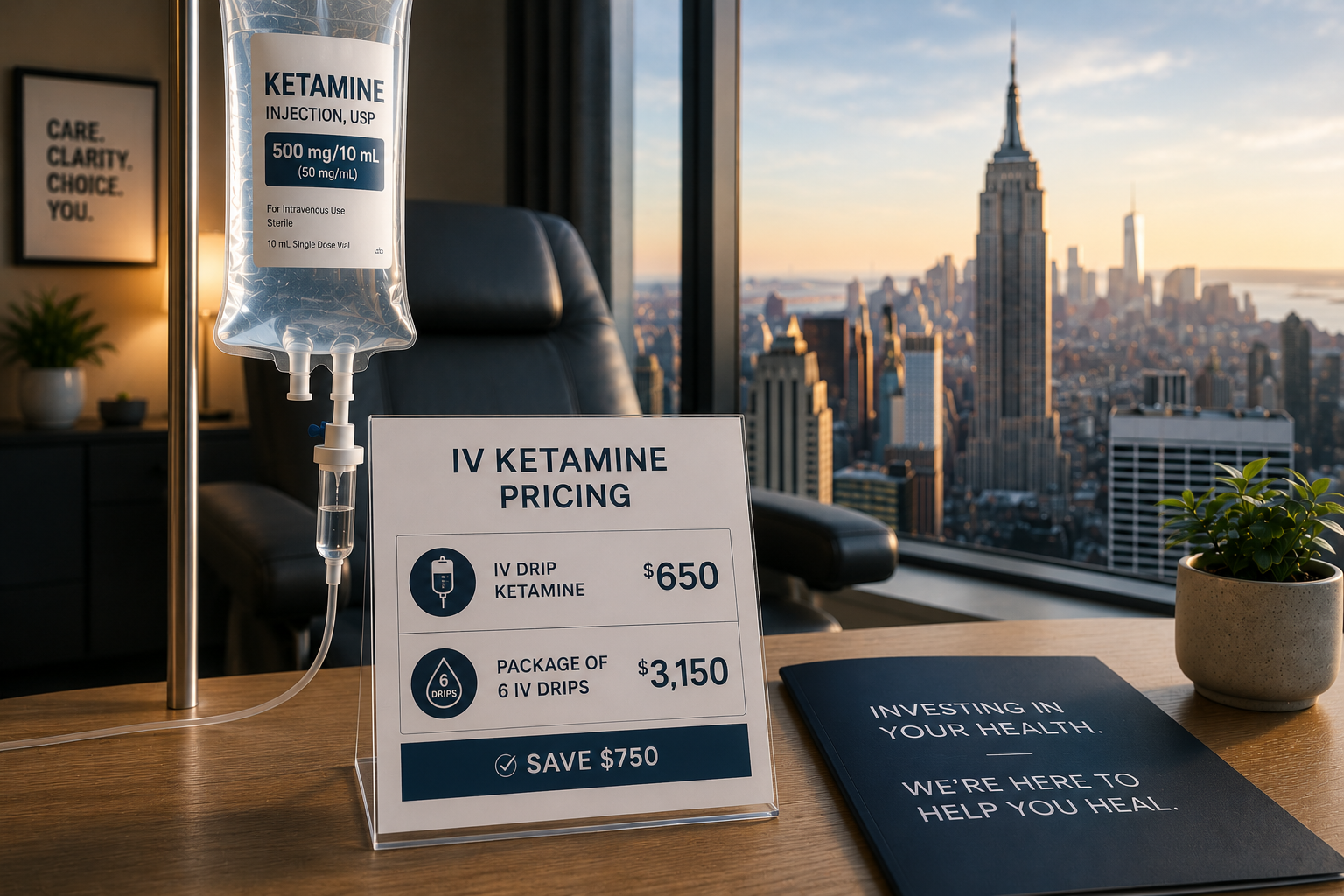
Ketamine Wellness NY pricing is structured for accessibility: $550 for an introductory session, $650 for a standard single session, and $3,250 for a six-session induction package.
Whatever you choose, ask about total cost before you start. Ask about prior authorization, session counts, and any maintenance visits. Cost questions are fair, and a clear answer builds trust.
Bring a short list of questions to your consultation. These help your provider understand what matters most to you.
A good provider will welcome these questions and answer them plainly. You deserve to feel informed, not rushed, at every step. Clear answers leave you more confident, whichever route you explore.
Not exactly, because Spravato contains esketamine, the S-form of ketamine. IV ketamine contains both mirror-image forms, and the two have separate approvals and delivery methods.
No universal answer exists, and neither treatment should be called categorically better. Both have research support, so the right option depends on your diagnosis, history, and provider guidance.
IV ketamine is delivered into the bloodstream by clinical staff, with dosing a clinician can adjust live. Spravato is a standardized nasal spray, self-administered under observation through an FDA-mandated program.
No, IV ketamine is FDA-approved as an anesthetic, and its use for depression is off-label. Spravato is FDA-approved for treatment-resistant depression, which is a separate regulatory status.
At Ketamine Wellness NY, an introductory IV session is $550 and a standard single session is $650. A six-session induction package costs $3,250, and we explain every cost before you begin.
We have two clinics, in Jackson Heights (Queens) and Great Neck (Long Island). We provide IV ketamine therapy only and do not offer or refer for Spravato.
Once you understand the ketamine therapy vs. esketamine Spravato differences, the options feel far less confusing. These are related treatments with separate compounds, approvals, and delivery methods.
Take your time, ask questions, and let your provider guide the decision. You deserve clear information and a care team that listens.
You have already taken a meaningful step toward clarity by reading this far. Whatever you choose, we hope you feel more prepared and less alone.
If you are searching for ketamine therapy NYC options, we are glad to talk. Ketamine Wellness NY provides IV ketamine therapy only, and we do not offer, administer, or refer patients for Spravato.
Dr. Qureshi’s board-certified internal medicine background, with clinical training at Brooklyn Hospital, NYU, and Henry J. Carter Hospital, matters here. It means your consultation starts with a careful, physician-led review of your whole health picture.
Start with an introductory IV ketamine session at $550. You can also visit us at our Jackson Heights (Queens) or Great Neck (Long Island) clinic. Schedule a consultation to discuss IV ketamine therapy for your situation.
You read one article, then another, and the names keep blending together. Ketamine, esketamine, Spravato: are they the same thing or not? That confusion is understandable, especially when you are already tired from living with depression.
Here, we explain the ketamine therapy vs. esketamine Spravato differences in plain language. We cover the compounds, the FDA status, and how each treatment is actually given.
At Ketamine Wellness New York, we provide IV ketamine therapy only, and we say so up front. That way, you can read this as a fair comparison, not a sales pitch. Questions like “which is better?” deserve careful answers, not shortcuts.
Our goal is simple: you leave knowing what separates these two options. That clarity makes your next conversation with a provider far easier. Let’s start with what each treatment actually is.
Ketamine and esketamine are close relatives, but they are not identical products. This section explains how the molecules relate and where the practical differences begin, so the rest of the comparison makes sense.
Spravato is not the same as ketamine. Spravato is a brand-name nasal spray whose active ingredient is esketamine, the S-form of ketamine. IV ketamine contains both mirror-image forms. The two are closely related, but they are separate products with different approvals and delivery methods.
Why does the mix-up happen? News stories and forums often use the names as if they mean one thing.
They are related, yet each has its own evidence, label, and rules. Esketamine is a refined, separately studied product, not a simple stand-in for infusion therapy. That distinction matters when you compare costs, safety rules, and what a session looks like.
The difference between ketamine and Spravato starts at the molecular level. Ketamine is a racemic mixture, which means it contains two mirror-image molecules called R-ketamine and S-ketamine.
Esketamine isolates the S-form and is sold as its own branded medication. Both compounds are thought to act on NMDA receptors and downstream neuroplasticity pathways. Researchers are still studying exactly how that produces an antidepressant effect.
Similar pathways do not make the products interchangeable. Formulation, route, and regulation all shape how each one is used. That is why a clinician cannot simply swap one for the other. Dose, timing, and monitoring all follow separate rules.
Approval status is where many online articles slip into imprecise claims. Here, we keep the facts exact and explain what a regulatory label does and does not tell you about effectiveness.
The FDA approved Spravato in March 2019 for adults with treatment-resistant depression. At first, it had to be used alongside an oral antidepressant.
In January 2025, the FDA expanded the label so Spravato can also be used on its own. A separate FDA indication covers depressive symptoms in adults with major depressive disorder with acute suicidal ideation or behavior, used with an oral antidepressant.
Spravato is available only through a certified healthcare setting under a REMS (Risk Evaluation and Mitigation Strategy) program. You cannot take it home, and staff observe you after every dose.
Why does that matter? It shapes scheduling, supervision, and insurance conversations. That structure is one reason approval status and treatment experience are linked.
IV ketamine is FDA-approved as an anesthetic, a use dating back decades. Its use for depression is off-label, meaning physicians prescribe an approved medication for a different indication. Off-label prescribing is legal and common across medicine.
Why no formal approval? Drug approval usually follows a manufacturer’s costly, product-specific pathway. Generic ketamine has less commercial incentive for that route.
Still, research supports its use: Marcantoni et al (2020) pooled trials of IV ketamine in treatment-resistant depression. Sanacora et al (2017) outlined consensus guidance on ketamine for mood disorders in JAMA Psychiatry.
Neither approval status is a verdict on which treatment works better. It reflects each product’s regulatory path, not a head-to-head ranking.
Many articles claim one treatment simply works better. The evidence does not support a blanket ranking.
At the 2026 annual meeting of the American Society of Clinical Psychopharmacology (ASCP), a retrospective review of health records comparing both treatments was presented. Records like these show associations, and they cannot prove that one treatment caused a difference.
A multi-site randomized trial from Yale researchers will compare the two, but results are several years away.
Research on suicidal ideation also exists for ketamine, including work by Wilkinson et al. (2017). Each source is useful, yet none settles the question alone. The honest answer is that your history and goals shape the better fit.
The two treatments feel quite different once you are actually in the chair. This section covers how each is delivered, who adjusts the dose, and how long you stay.
An IV ketamine infusion delivers medication directly into your bloodstream through a small catheter. Dr. Pervaiz Qureshi, MD, board-certified in internal medicine, reviews each patient’s history before an infusion plan begins.
In most published research, the dose is 0.5 mg/kg infused over about 40 minutes; at Ketamine Wellness New York, infusions run 40 to 90 minutes depending on your protocol. Because the medication enters the bloodstream directly, a clinician can adjust the rate in real time.
A Common Scenario
A patient finds the first ten minutes of an infusion too intense. The clinician slows the rate and checks in, and the patient continues comfortably.
Many patients begin with an induction series of six infusions over two to three weeks. Maintenance sessions typically follow at intervals of one to three months.
Spravato nasal spray follows a standardized dosing protocol set by its FDA-approved label. You self-administer the spray, but only under direct observation in a certified setting.
Staff monitor you for at least two hours after each dose under REMS requirements. The dose does not change mid-session the way an infusion rate can.
In a Spravato nasal spray vs ketamine infusion comparison, the biggest practical gap is dose flexibility. The FDA prescribing label reports nasal bioavailability of about 48%, while IV delivery reaches the bloodstream directly.
Your prescriber follows the label’s schedule, which keeps the structure consistent. Both treatments involve real supervised time at the point of care.
This table places IV ketamine vs Spravato side by side, so you can scan the key facts quickly. Each row reflects what we covered above, with no claim about which option is better.
| IV Ketamine | Spravato (Esketamine) | |
|---|---|---|
| Compound | Racemic ketamine (R- and S-forms) | Esketamine (S-form only) |
| FDA status | FDA-approved as an anesthetic; off-label for depression | FDA-approved for treatment-resistant depression (2019) and depression with acute suicidal ideation or behavior |
| Delivery | IV infusion given by clinical staff | Nasal spray, self-administered under observation |
| Dosing | Adjustable by a clinician in real time (mood protocols typically 0.5 mg/kg over about 40 minutes) | Standardized dosing set by the FDA label |
| Regulatory framework | Off-label physician prescribing | FDA REMS program with mandatory in-office observation |
| Monitoring | Throughout the infusion and recovery | At least two hours after each dose |
| Cost pattern | Typically paid out-of-pocket ($550 introductory session at Ketamine Wellness NY) | More commonly covered by insurance, depending on your plan |
| Offered at Ketamine Wellness NY | Yes, at Jackson Heights (Queens) and Great Neck (Long Island) | No, we do not offer, administer, or refer for Spravato |
Takeaway: They are related but separate treatments, and your history and provider guidance decide the fit.
No blog post can choose a treatment for you, and we will not try. We can, however, describe the common patterns that patients and providers often talk through together in a consultation.
No universal answer exists, because both treatments have clinical research behind them. The better fit depends on your diagnosis, prior treatments, and provider guidance.
Some patients tried Spravato first, often because insurance covered it, and later explored IV ketamine after limited relief. Others are hearing about both options for the first time.
Preference around nasal spray versus infusion also matters. Your response to past medications, your schedule, and your comfort with each setting all count.
Neither path makes one treatment the right choice for everyone. Treat these points as conversation starters, not as rules. A thoughtful provider will walk through all of these with you.
Insurance often shapes real decisions more than any efficacy comparison. Spravato’s FDA approval means it is more commonly covered by insurance, depending on the plan.
IV ketamine for depression is off-label, so it is typically paid out-of-pocket. You can read more about whether ketamine is covered by insurance in our guide.
Ketamine Wellness NY pricing is structured for accessibility: $550 for an introductory session, $650 for a standard single session, and $3,250 for a six-session induction package.
Whatever you choose, ask about total cost before you start. Ask about prior authorization, session counts, and any maintenance visits. Cost questions are fair, and a clear answer builds trust.
Bring a short list of questions to your consultation. These help your provider understand what matters most to you.
A good provider will welcome these questions and answer them plainly. You deserve to feel informed, not rushed, at every step. Clear answers leave you more confident, whichever route you explore.
Not exactly, because Spravato contains esketamine, the S-form of ketamine. IV ketamine contains both mirror-image forms, and the two have separate approvals and delivery methods.
No universal answer exists, and neither treatment should be called categorically better. Both have research support, so the right option depends on your diagnosis, history, and provider guidance.
IV ketamine is delivered into the bloodstream by clinical staff, with dosing a clinician can adjust live. Spravato is a standardized nasal spray, self-administered under observation through an FDA-mandated program.
No, IV ketamine is FDA-approved as an anesthetic, and its use for depression is off-label. Spravato is FDA-approved for treatment-resistant depression, which is a separate regulatory status.
At Ketamine Wellness NY, an introductory IV session is $550 and a standard single session is $650. A six-session induction package costs $3,250, and we explain every cost before you begin.
We have two clinics, in Jackson Heights (Queens) and Great Neck (Long Island). We provide IV ketamine therapy only and do not offer or refer for Spravato.
Once you understand the ketamine therapy vs. esketamine Spravato differences, the options feel far less confusing. These are related treatments with separate compounds, approvals, and delivery methods.
Take your time, ask questions, and let your provider guide the decision. You deserve clear information and a care team that listens.
You have already taken a meaningful step toward clarity by reading this far. Whatever you choose, we hope you feel more prepared and less alone.
If you are searching for ketamine therapy NYC options, we are glad to talk. Ketamine Wellness NY provides IV ketamine therapy only, and we do not offer, administer, or refer patients for Spravato.
Dr. Qureshi’s board-certified internal medicine background, with clinical training at Brooklyn Hospital, NYU, and Henry J. Carter Hospital, matters here. It means your consultation starts with a careful, physician-led review of your whole health picture.
Start with an introductory IV ketamine session at $550. You can also visit us at our Jackson Heights (Queens) or Great Neck (Long Island) clinic. Schedule a consultation to discuss IV ketamine therapy for your situation.