Key Takeaways – Ketamine For Sleep
- Many people sleep better during ketamine treatment, but typically because mood and anxiety improve not because ketamine functions as a sleep medication
- Research on ketamine and sleep is encouraging but limited. Nearly all of it studies sleep within the context of depression, not insomnia as a standalone condition
- Some patients feel alert or “wired” the night of an infusion. Improvement tends to emerge across a series, not after a single session
- For suspected sleep apnea, circadian-rhythm disorders, or primary insomnia with no mood component, a sleep-medicine evaluation comes first
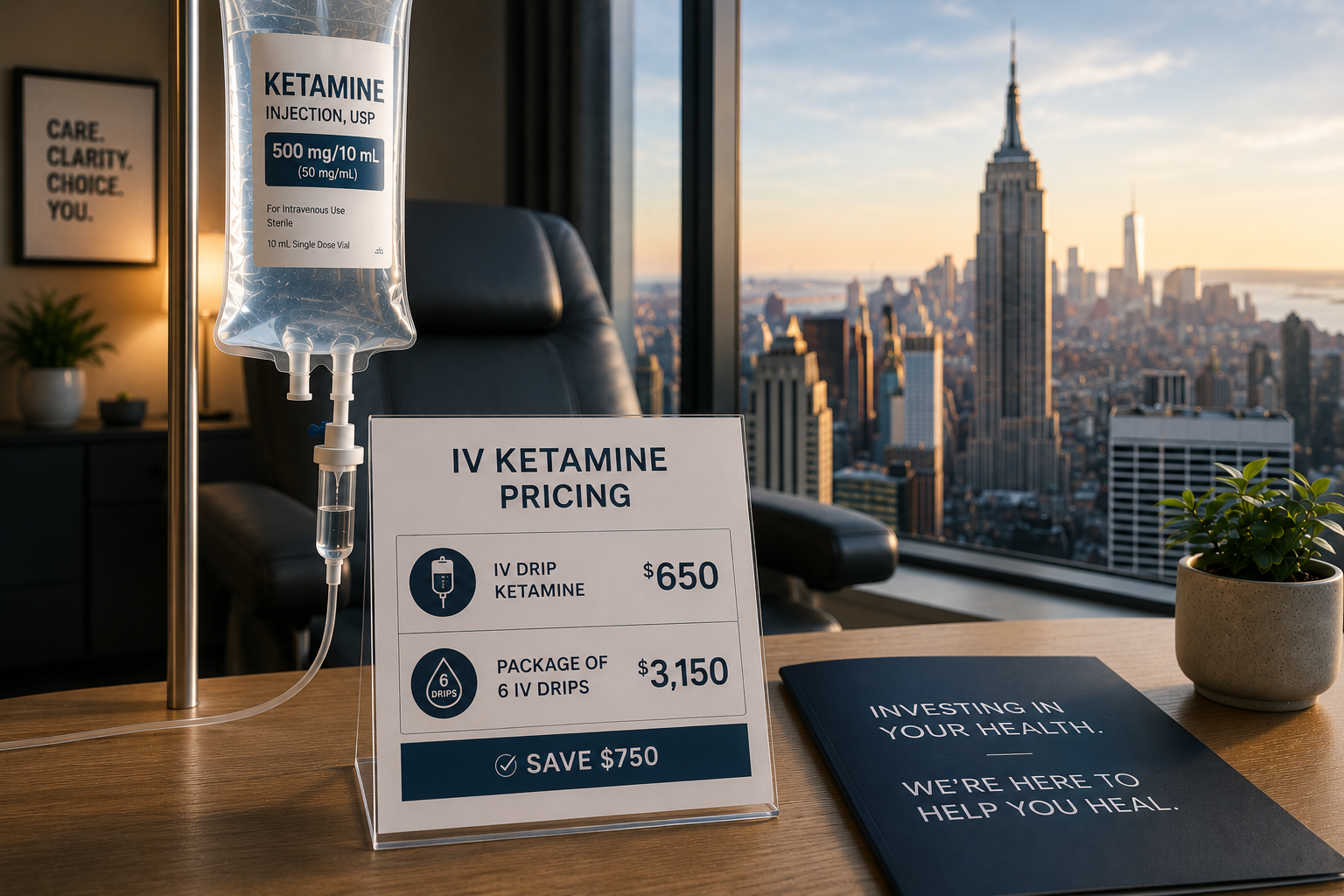
- Ketamine Wellness NY pricing: $550 for an introductory session, $650 for a standard single session, and $3,250 for a six-session induction package
Why Sleep and Mood Are So Deeply Connected
Sleep problems are rarely isolated. For many people dealing with depression, anxiety, or PTSD, poor sleep is not a separate condition. It is a symptom woven through the whole picture.
Insomnia, restless nights, and early-morning waking are among the most common signs of depression and anxiety disorders. They are also among the most stubborn to shift, often lingering even after other symptoms ease.
Sleep disruption and low mood reinforce each other in a direct way. A poor night makes the next day harder. A harder day makes the next night worse. That cycle is exactly why improving mood tends to improve sleep along with it.
And that’s why ketamine therapy for insomnia in New York is typically discussed in the context of treating mood disorders rather than sleep disorders.
Based on privacy-protected patient patterns commonly reported across treatment-resistant depression cases:
“I had not slept more than a few hours straight in over two years. After my third infusion, I woke up and realized I had slept through the night. The depression had started lifting, and the sleep just followed along with it. I did not even connect them at first.”
This experience reflects what many patients with treatment-resistant depression describe. Better sleep tends to arrive as the mood improves, not as a separate outcome.
What The Research Says About Ketamine For Sleep
Ketamine and sleep quality is an area where the science is promising but still developing. Most studies examine sleep as part of depression treatment and not insomnia on its own. That distinction matters a great deal.
The Systematic Review Evidence
A 2023 systematic review published in Pharmaceuticals examined five studies on ketamine and sleep in treatment-resistant depression. It found reduced insomnia symptoms but concluded that evidence remains limited and more high-quality research is needed.
Notably, two of those five studies used overnight EEG measurements. Both found reduced nighttime wakefulness alongside increases in slow-wave (deep) and REM sleep.
A Large Retrospective Study
A review by Yan and colleagues (2024) discusses retrospective studies on this question, including one 323-patient study of TRD patients receiving IV ketamine.
Results showed that these patients have statistically significant improvements in insomnia symptoms, nighttime restlessness, and early morning waking across the course of treatment.
The Glutamate Connection
NIMH researchers Duncan, Ballard, and Zarate studied how effects of ketamine on the glutamate system may influence sleep and wakefulness. Ketamine elevates extracellular glutamate in the prefrontal cortex.
That mechanism appears to have downstream effects on slow-wave sleep, and may be tied to the drug’s rapid antidepressant action.
A Note On Mixed Findings
Not all studies align neatly. A 2024 analysis published in Pharmacological Reports, evaluated self-reported sleep in 28 inpatients with treatment-resistant depression. It found no statistically significant improvement in sleep after eight IV ketamine infusions.
The authors suggested that the small sample size may have influenced the findings. This shows the need for larger studies to better understand ketamine’s effects on sleep.
Simply Put:
The picture is genuinely mixed. Anyone claiming ketamine “resets sleep” is overstating what the evidence supports. But the evidence leaning toward improvement, especially in patients with mood disorders, is real and worth taking seriously.
Ketamine: Sleep Medication Or A Secondary Benefit
Two things are true at once here, and both matter for setting accurate expectations.
Remember, Ketamine Is Not A Sleeping Pill
For most people who report better sleep during ketamine treatment, the benefit is indirect. As depression, anxiety, or PTSD eases, sleep follows. Ketamine is not prescribed at Ketamine Wellness NY to treat a sleep disorder on its own.
Can ketamine help insomnia? Yes, but only when insomnia is because of an underlying mood disorder. No protocols exist for using IV ketamine as a primary treatment for insomnia, and it is not prescribed the way a sleep specialist would treat a standalone sleep disorder.
Why Sleep May Be Worse After An Infusion
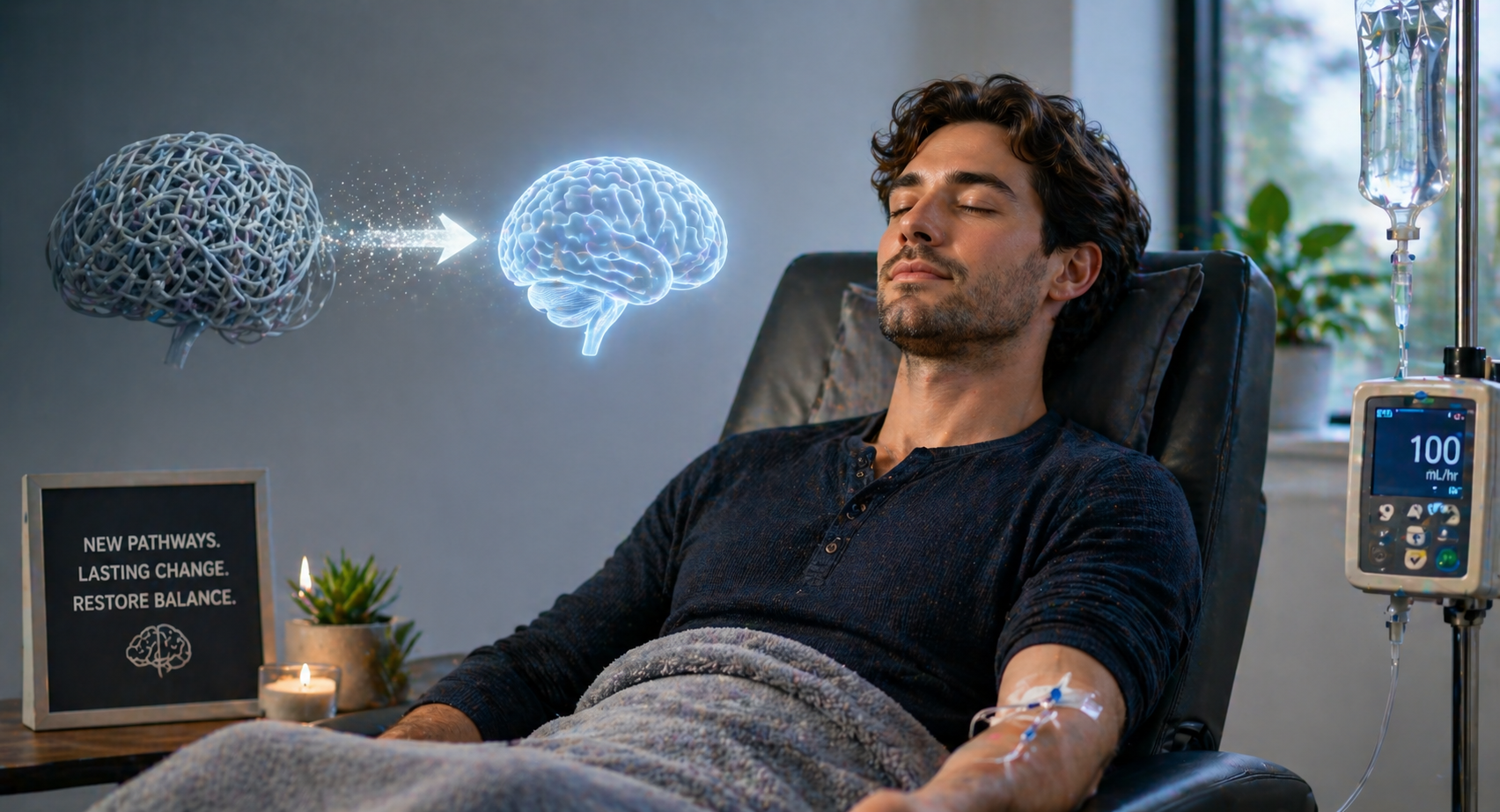
Some people feel alert or “wired” for a few hours after an infusion. It is a mild stimulant-like effect that can make sleep harder that evening. This is short-lived, and very different from the broader trend that can emerge across a series.
Accurate expectations matter more than reassuring ones. Scheduling sessions earlier in the day and keeping the evening calm can help minimize this effect.
A 2025 pilot study in Pharmaceuticals examining esketamine add-on therapy in TRD explored this complexity further. It noted that insomnia and antidepressant response interact in ways that are not yet fully understood.
Who Might Notice Better Sleep After Infusion?
Does ketamine help you sleep? So, as mentioned earlier, the answer depends entirely on what is driving the sleep problem.
When Ketamine May Help Sleep Indirectly
If your sleep problems are part of a broader picture of depression, anxiety, or PTSD, treating those conditions may well improve your sleep. This is where IV ketamine has a genuine, research-supported role for patients where standard treatments have not worked.
The sleep benefit, when it occurs, tends to track with mood improvement over a series of sessions. It rarely appears after a single infusion.
Ketamine therapy at Ketamine Wellness NY is considered for conditions like treatment-resistant depression, anxiety disorders, and PTSD. These are conditions where insomnia is often a symptom, not the primary diagnosis.
Quick Key Point:
Sleep improvement is not guaranteed, and it is not the primary goal of treatment at Ketamine Wellness NY. But for patients whose poor sleep stems from these conditions, it is a meaningful benefit that many do experience.
When To See A Sleep Specialist Instead
If your sleep difficulty stands on its own, a sleep-medicine evaluation is the right first step. This includes suspected sleep apnea, circadian-rhythm disorders, or primary insomnia without an underlying mood disorder. Ketamine therapy would not be appropriate in that situation.
Ketamine Wellness NY would communicate this directly during an intake conversation. Referring patients to the right kind of care is part of what medically supervised treatment looks like.
How Ketamine Wellness New York Approaches This
Ketamine Wellness NY provides monitored, in-clinic IV ketamine therapy at our Jackson Heights (Queens) and Great Neck (Long Island) locations.
Every treatment is supervised by Dr. Qureshi. His board-certified internal medicine background, with clinical training at Brooklyn Hospital, NYU, and Henry J. Carter Hospital ensures each session is medically sound.
When insomnia is part of depression, anxiety, or PTSD, a consultation can help determine whether ketamine is an appropriate option. We do not promise sleep improvement as a primary outcome.
Instead, we focus on treating the underlying conditions that often contribute to poor sleep while setting realistic expectations about potential sleep-related benefits.
Self-pay pricing:
| Session Type | Price |
| Introductory IV ketamine session | $550 |
| Standard single session | $650 |
| Six-session induction package | $3,250 |
To learn about ketamine insurance coverage or our treatment process, schedule a consultation with our team.
Frequently Asked Questions (FAQs)
Can I get ketamine just for insomnia?
No. Ketamine Wellness NY does not treat isolated sleep disorders with ketamine. IV ketamine is considered for conditions like treatment-resistant depression, anxiety, and PTSD. Sleep is one symptom that may improve as those conditions respond but it is not a standalone indication.
Does ketamine cause insomnia or make sleep worse?
For some patients, yes, and on the night of an infusion. A mild stimulant effect can make it harder to fall asleep that evening. Scheduling sessions earlier in the day tends to reduce this. Across a full series, the broader trend is often toward improved sleep.
How long until sleep improves during ketamine treatment?
If sleep does improve, it typically tracks with mood improvement, which builds across a series of infusions, not after one. There is no reliable timeline, and not every patient notices a sleep benefit.
how much does ketamine therapy cost in New York?
At Ketamine Wellness NY, an introductory IV ketamine session is $550. A standard single session is $650, and a six-session induction package is $3,250. These are self-pay rates. In certain conditions, ketamine therapy is also covered by insurance.
Is IV ketamine different from Spravato (esketamine) for sleep effects?
Both IV ketamine and Spravato (esketamine) have shown sleep-related improvements in TRD studies. IV ketamine offers provider-adjustable dosing that can be tailored to individual response, while Spravato uses a standardized nasal-spray protocol. A Ketamine Wellness NY consultation can help identify the right treatment approach for your situation.
Final Thoughts on Ketamine Therapy for Insomnia in New York
Sleep and mood are intertwined in ways that medicine is still fully mapping. The research on ketamine for sleep is promising enough to take seriously, and incomplete enough to treat carefully.
For patients where poor sleep is due to depression or anxiety, ketamine therapy may offer a genuine path forward. It works not as a sleep medication, but as treatment for the underlying conditions that so often steal sleep in the first place.
 Skip to content