


Bipolar depression can feel heavier than any other low you have lived through. Standard antidepressants may not help, and they can sometimes make mood swings worse. It makes sense that you, or someone you love, would start asking about ketamine.
Ketamine and bipolar depression is a more complicated topic than ketamine for standard depression. The research is promising, but it is smaller, newer, and less settled. You deserve a clear and honest answer here.
In this guide, we explain what ketamine therapy can and cannot offer in bipolar depression. We cover the evidence, the manic-switch risk, and why careful screening comes first.
You will also see how treatment is approached safely when it is appropriate. Our goal is clarity, so you can make decisions alongside your psychiatric provider.
What The Research On Ketamine and Bipolar Depression Shows
This section separates the evidence for bipolar depression from the larger body of research on unipolar depression. We cover what studies found, what the newest trial added, and where the limits remain.
Does ketamine help bipolar depression?
Some small controlled trials show that adding ketamine to a mood stabilizer can quickly ease depressive symptoms in some people. The evidence is promising but limited, the use is off-label, and results vary from person to person.
What Early Trials Found
Early studies gave this question its first real footing. Diazgranados et al. (2010) tested a single IV infusion in people with treatment-resistant bipolar depression. Every participant stayed on lithium or valproate throughout.
Zarate et al. (2012) later replicated the add-on design with a similar direction of results. Both trials used 0.5 mg/kg over 40 minutes, the dose typically used in mood protocols. Depressive symptoms eased within hours in some participants.
Both of these early studies were small, brief, and tightly controlled. They showed the idea deserved further testing, but did not settle the question. That distinction matters when you read headlines about rapid relief.
What The 2026 Ket-BD Trial Added
A randomized trial published on September 2, 2026 in JAMA Psychiatry added important new data. The Ket-BD trial enrolled 68 adults with bipolar I or II depression. All had failed at least two evidence-based medications, and all stayed on a mood stabilizer or antipsychotic.
Participants received ketamine or midazolam, an active comparison drug, on top of that regimen. Researchers reported lower depression scores in the ketamine group at day 14. They also reported no mania, hypomania, or psychosis in either group.
The research team reported that benefits lasted about one week after the final infusion. A trial of 68 people cannot rule out rare switches, so screening still matters.
Why Unipolar Evidence Does Not Transfer Directly
Most research on ketamine for depression studied unipolar cases, where the evidence base is considerably larger. Many bipolar readers see those results and assume they apply equally. Our general page covers that broader topic, while this article stays focused on bipolar depression.
Bipolar disorder involves manic or hypomanic highs as well as depression. That changes both the risk profile and the way researchers design studies. The table below lays out the main differences between the two.
Trials in bipolar depression have also tended to be smaller and considerably more recent. Many trials also screened out people with active mania. Those choices make the findings narrower than they first appear to readers.
| Question | Unipolar depression | Bipolar depression |
|---|---|---|
| Size of evidence base | Larger and more mature | Smaller and more recent |
| Concurrent medication in trials | Varies by trial | Mood stabilizer or antipsychotic maintained |
| Added safety concern | Dissociation and blood pressure changes | Manic or hypomanic switching, plus those effects |
| Current status | Widely used off-label; esketamine approved for treatment-resistant depression | Off-label; considered after standard options |
Takeaway: Unipolar results are a helpful backdrop, but they are not proof for bipolar depression.
Where The Evidence Still Falls Short
Sample sizes remain small, and follow-up is usually short. Researchers describe the findings as promising but in need of larger, longer studies. That is why we avoid calling this treatment established.
Ketamine’s effect on suicidal ideation in bipolar depression is another open question. Wilkinson et al. (2017) found rapid reductions in suicidal thoughts across ketamine studies. Findings specific to bipolar depression are less consistent across studies.
New trials are already being planned, which is encouraging for patients. A phase 2A study of oral ketamine capsules for treatment-resistant bipolar depression has an estimated start date of October 2026. Completion is estimated for 2028, so answers will take time.
Why Ketamine Screening For Bipolar Disorder Comes First
Safe care centers on screening, not a formality or a box to tick. This section explains the manic-switch risk, why a mood stabilizer matters, and what a responsible evaluation actually involves.
How Real Is The Manic-Switch Risk?
We want to state this risk plainly, without softening it. Ketamine can trigger manic or hypomanic symptoms in some people with bipolar disorder. This risk appears in case reports and, less often, in clinical trials.
The Ket-BD trial saw no switches, which is reassuring. A single trial cannot tell us how rare the risk truly is. Real-world patients are often more complex than trial participants, with more medications and more history.
That is why we treat monitoring as part of care, not an afterthought. Any change in sleep, energy, or mood matters. Early reports let your care team respond quickly and calmly.
Why A Mood Stabilizer Matters
Most bipolar ketamine studies kept participants on a mood stabilizer throughout. Lithium, lamotrigine, and valproate are common examples of mood stabilizers. Some trials also allowed an atypical antipsychotic as the background medication.
The working theory is simple, though it is not yet proven. Ketamine acts quickly on depressive symptoms, while a mood stabilizer works to steady the mood cycle itself. In other words, the stabilizer may cover the manic side of the illness.
We need to be careful about how we read that pattern. Studies show an association between this setup and few switches, not proof of protection. For that reason, we never describe ketamine as a standalone option.
What A Responsible Screening Involves
At Ketamine Wellness New York, evaluation starts with your existing diagnosis and mood history. Dr. Pervaiz Qureshi, MD, board-certified in internal medicine, leads the clinical review. The review covers past mood episodes, including any history of mania or hypomania.
We also review every current medication, especially your mood stabilizer. Your psychiatric provider stays involved so everyone works from the same information. The APA consensus statement by Sanacora et al. (2017) also stresses careful patient selection and monitoring.
Dr. Qureshi’s board-certified internal medicine background, with clinical training at Brooklyn Hospital, NYU, and Henry J. Carter Hospital, matters here. It helps us assess blood pressure, heart health, and how your body responds to infusion. Only a licensed psychiatric evaluation can confirm a bipolar diagnosis.
A Common Scenario
A patient stable on lamotrigine for years contacts a clinic expecting a yes or a flat no. Instead, the evaluation covers past mood episodes and current medication, and the patient’s psychiatrist joins the plan. The patient leaves understanding why the process takes time, and feeling taken seriously.
How IV Ketamine For Bipolar Depression Is Approached Safely
When evaluation shows ketamine may be appropriate, the plan stays collaborative, careful, and closely monitored. This section covers coordinated care, protocol details, and typical costs for ketamine infusion for bipolar disorder.
Coordinated Care With Your Psychiatric Provider
When ketamine is appropriate, it is added to your mood stabilizer, never used in place of it. Your psychiatric provider and our team share the same diagnosis, medication history, and current mood information. That coordination keeps everyone working toward one shared plan.
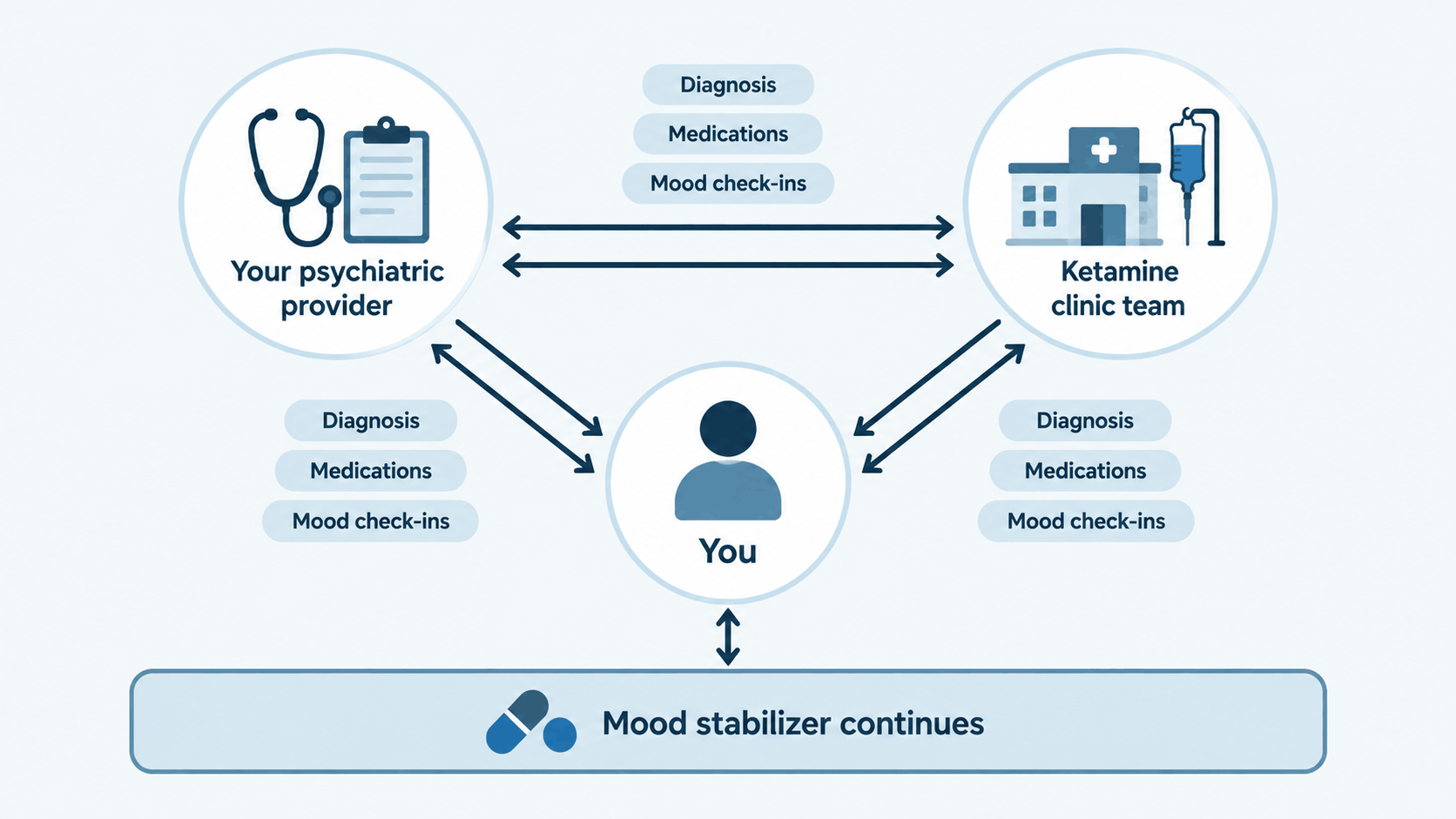
This model is what makes ketamine treatment for bipolar depression different from standard depression care. A single intake visit followed by a standalone infusion series is not enough.
Close oversight means regular check-ins on sleep, energy, irritability, and mood. It also includes the physical monitoring used for any ketamine infusion. Our medically monitored clinic setting makes both of these possible.
What A Typical IV Protocol Looks Like
In most published research, the dose is 0.5 mg/kg of IV ketamine over 40 minutes; at Ketamine Wellness New York, infusions run 40 to 90 minutes depending on your protocol. A standard induction series includes six sessions in total. At Ketamine Wellness New York, the six infusions are scheduled across two to three weeks.
After induction, maintenance series typically occur one to three months apart. Your provider adjusts that timing based on your response and mood stability. Maintenance is important because benefits may fade once infusions stop.
Trial protocols differ from clinic protocols, and a standardized bipolar-specific schedule is still lacking. The Ket-BD trial, for example, used four infusions over two weeks. Your plan should be individualized and reviewed with your psychiatric provider.
What Does Treatment Cost?
Ketamine Wellness NY pricing is structured for accessibility. An introductory session is $550, a standard single session is $650, and a six-session induction package is $3,250.
Many people ask about coverage for off-label ketamine treatment before booking. We explain how to think about whether ketamine is covered by insurance in a separate guide.
Cost should never be the reason to skip evaluation or monitoring. Your evaluation comes first, so we know whether treatment fits before you commit.
We encourage you to bring your current medication list and your psychiatric provider’s contact details. Ask us anything about the process before you decide.
Bipolar Depression Treatment Options Beyond Ketamine
Ketamine belongs inside a wider treatment plan, not outside it or ahead of it. This section reviews established bipolar depression treatment options and explains where ketamine may fit after those have been tried.
Established First-Line Care
Mood stabilizers remain the foundation of bipolar depression treatment. Lithium, lamotrigine, and valproate are the most familiar examples. Certain atypical antipsychotics are also well-established options for bipolar depression.
Structured psychotherapy supports these medications and helps with relapse prevention. Each of these options has stronger research behind it for bipolar disorder specifically. Your psychiatric provider decides which combination fits your history.
Most treatment plans are built around these options first. Standard care comes first because it protects you from unnecessary risk.
Ketamine is not a shortcut around this foundation. It is a possible addition for people who still lack relief after these options.
Where Ketamine May Fit
Ketamine therapy for bipolar disorder is generally considered only after standard options have not helped enough. A specialist familiar with bipolar disorder and ketamine should make that call; it should never be a default choice.
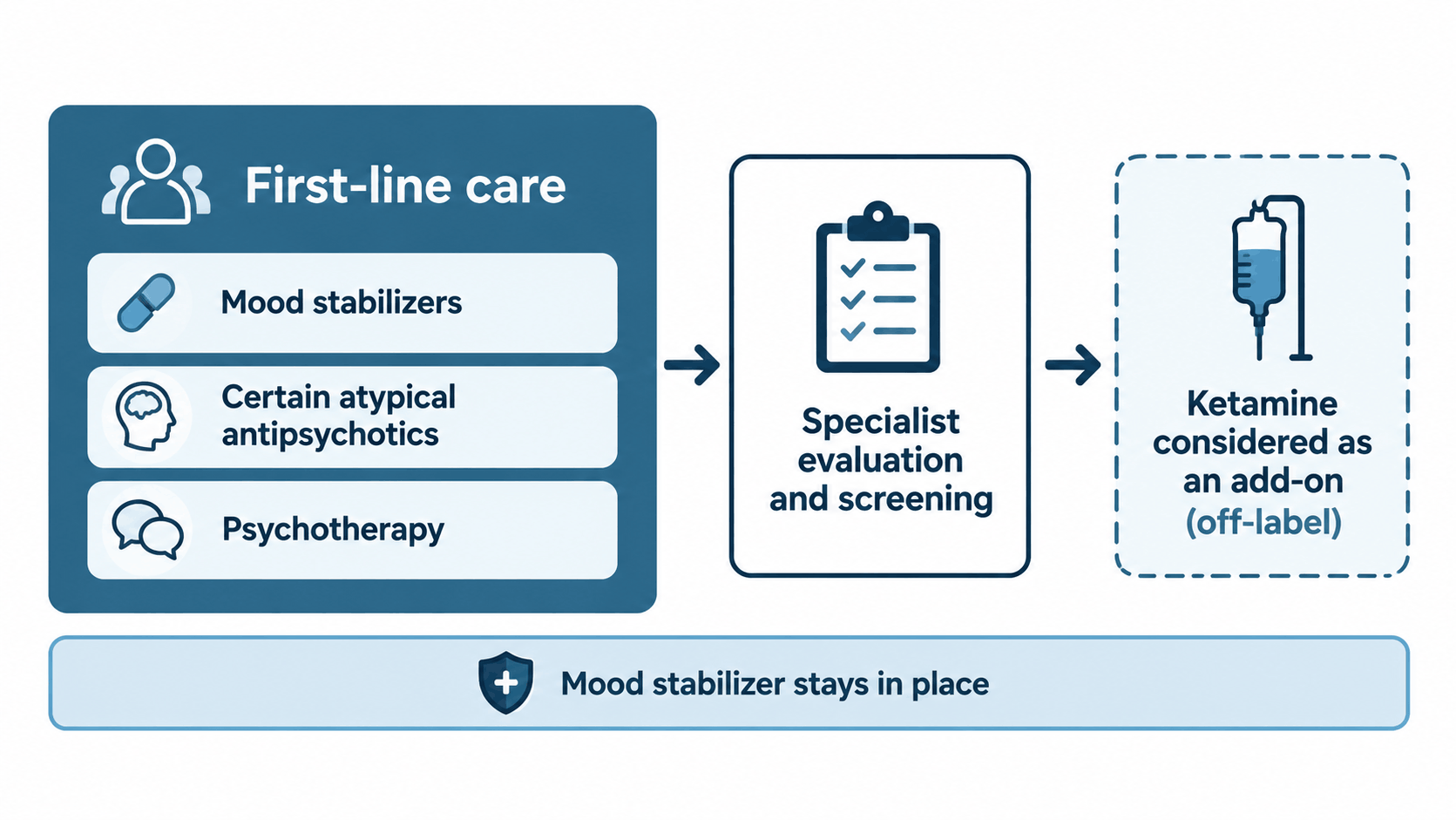
Ketamine and bipolar disorder will likely stay a careful, case-by-case topic for years. Even with encouraging new data, ketamine remains off-label for this condition. Spravato (esketamine) is FDA-approved for treatment-resistant depression and for depressive symptoms in adults with major depressive disorder with acute suicidal ideation or behavior, not for bipolar depression.
That context is why this decision belongs in a conversation with your psychiatrist first. Bring your questions, and bring the people who support you. If you are a caregiver, you are welcome to join those conversations.
Frequently Asked Questions (FAQs)
Does ketamine help bipolar depression?
It may help some people, but the evidence is still developing. Trials add ketamine to a mood stabilizer, and results vary from person to person. It is off-label and never a first-line choice.
Is ketamine safe for people with bipolar disorder?
Ketamine can trigger manic or hypomanic symptoms in some people with bipolar disorder. That is why screening, a current mood stabilizer, and ongoing monitoring are essential. A 2026 randomized trial reported no switches, but one trial cannot remove the risk.
What does ketamine screening for bipolar disorder involve?
A screening visit reviews your diagnosis, past mood episodes, and current medications, especially your mood stabilizer. We coordinate with your psychiatric provider throughout the entire process. The goal is to decide whether ketamine is a safe, monitored option for you.
Is IV ketamine a first-line treatment for bipolar depression?
No, it is not a first-line treatment for bipolar depression. Mood stabilizers, certain atypical antipsychotics, and psychotherapy remain first-line. IV ketamine for bipolar depression is considered only as an add-on after specialist evaluation.
How much does ketamine therapy cost in NYC?
At Ketamine Wellness NY, an introductory session is $550 and a standard single session is $650. A six-session induction package costs $3,250 in total. Your evaluation comes first, so we confirm treatment fits before you commit.
Where in NYC is Ketamine Wellness NY located?
We have two clinics, one in Jackson Heights (Queens) and one in Great Neck (Long Island). You can visit whichever location is easier for you.
Schedule An Evaluation For Ketamine Therapy NYC
If standard treatments have not given enough relief, a clinical evaluation may be a reasonable next step. It helps you and your psychiatric provider decide whether ketamine fits your broader bipolar treatment plan.
Ketamine Wellness NY offers thorough evaluations to anyone researching ketamine therapy NYC options, including caregivers. If the evaluation shows ketamine is appropriate, you can start with an introductory IV ketamine session at $550.
You can also visit us at our Jackson Heights (Queens) or Great Neck (Long Island) clinic. Schedule a consultation to begin your full clinical evaluation with our team.
Final Thoughts
Ketamine and bipolar depression is a topic that deserves patience and precision. The research is encouraging, and the 2026 trial adds welcome new data.
Still, the evidence remains smaller than for unipolar depression, and manic-switch risk is real. Careful screening, coordination with your mood stabilizer, and close monitoring protect you at every step.
You deserve honest information, a clear plan, and a team that takes your diagnosis and your questions seriously.
Resources
- Diazgranados et al. (2010). A Randomized Add-on Trial of an N-methyl-D-aspartate Antagonist in Treatment-Resistant Bipolar Depression
https://jamanetwork.com/journals/jamapsychiatry/fullarticle/210856 - Zarate et al. (2012). Replication of Ketamine's Antidepressant Efficacy in Bipolar Depression: A Randomized Controlled Add-On Trial
https://www.biologicalpsychiatryjournal.com/article/S0006-3223%2811%2901210-8/abstract - Orsini et al. (2026). Serial Ketamine Infusions for Treatment-Resistant Bipolar Depression
https://jamanetwork.com/journals/jamapsychiatry/article-abstract/2853662 - Wilkinson et al. (2017). The Effect of a Single Dose of Intravenous Ketamine on Suicidal Ideation: A Systematic Review and Individual Participant Data Meta-Analysis
https://psychiatryonline.org/doi/full/10.1176/appi.ajp.2017.17040472 - Ishrat Husain (2026). Adjunctive Oral KET-AD Capsules in Treatment Resistant Bipolar Depression
https://clinicaltrials.gov/study/NCT07644767 - Sanacora et al. (2017). A Consensus Statement on the Use of Ketamine in the Treatment of Mood Disorders
https://jamanetwork.com/journals/jamapsychiatry/article-abstract/2605202