Skip to content
You did the work. You spoke with your psychiatrist, gathered your medication history, submitted the paperwork, and waited. Then the denial letter arrived.
A ketamine insurance denial can feel like a closed door. After months of treatment that didn’t work, ketamine therapy may have felt like the next reasonable step, and the denial can read like a verdict on whether you’ll ever get relief.
It isn’t a verdict. It’s a procedural outcome, and there are real next steps available to you. Some of them involve appealing the denial. Others involve looking at the situation differently and considering paths forward that don’t depend on your insurer changing its mind.
This guide walks through both. It is written honestly, without selling you a service we don’t provide. Ketamine Wellness New York does not handle insurance appeals, but we can explain the landscape clearly and tell you where we fit and where we don’t.
By submitting this form you agree to be contacted via phone/text/email.
Before deciding what to do next, it helps to know what kind of denial you received. The answer shapes everything that follows.
If your Spravato (esketamine) request was denied, this is usually appealable. Spravato has FDA approval for treatment-resistant depression, and major insurers including Aetna, Cigna, United Healthcare, and many Medicare and Medicaid plans have established coverage pathways for it. When Spravato is denied, the cause is most often documentation: incomplete proof of failed antidepressant trials, an outdated PHQ-9 or MADRS score, missing prescriber notes, or a coding error on the claim. These are correctable, and many initial denials are overturned on appeal.
If your IV ketamine request was denied, the situation is different. Most major insurers classify IV ketamine for depression, anxiety, PTSD, OCD, and chronic pain as experimental, investigational, or off-label. Aetna’s Clinical Policy Bulletin #0938 is a representative example. Appeals on these denials rarely succeed because the issue is not documentation but policy. The insurer is not denying your specific case; it is declining to cover the treatment category. You can still appeal, and a small number of cases do get reversed, but the realistic odds are low.
If you were denied for both, the next steps differ depending on which one your clinician recommended in the first place. The Spravato path is worth pursuing through appeal. The IV ketamine path generally is not, unless your plan has unusually flexible out-of-network behavioral health benefits.
| Feature | Spravato | IV Ketamine |
|---|---|---|
| FDA approval for psychiatric use | Yes (TRD, depression with suicidality) | No (off-label) |
| Insurance coverage pathway | Established with major insurers | Generally not covered |
| Administration | Nasal spray | Intravenous infusion |
| Setting | REMS-certified clinic only | Standard medical clinic |
| Conditions treated | Depression only | Depression, anxiety, PTSD, OCD, chronic pain |
| Dose flexibility | Fixed protocol | Adjustable per patient |
| Typical cost (cash) | High without insurance | $550–$800 per session in NYC market |
If your denial concerns Spravato, knowing the typical triggers helps you understand whether your case is fixable.
Incomplete proof of failed antidepressant trials. Most insurers apply what is informally called the “Rule of Two.” To qualify for Spravato coverage under treatment-resistant depression criteria, your records need to show at least two antidepressants from different drug classes that were tried at therapeutic doses, for an adequate duration (usually four weeks), and discontinued due to lack of response or intolerable side effects. Specific start dates, stop dates, doses, and reasons for discontinuation matter. Missing any of these details often triggers an automatic denial that has nothing to do with whether you actually have treatment-resistant depression.
Outdated depression rating scores. Some Spravato policies require a current PHQ-9 score, sometimes within the previous four weeks, often at a threshold of 15 or higher. Scores from months ago, even if they were accurate at the time, may not satisfy the requirement.
Billing or coding errors. Sometimes the denial has little to do with the clinical case. The wrong code may have been used, modifiers may be missing, or the prior authorization may have been attached to the wrong service line. These are administrative issues, not medical ones, and they are usually fixable through resubmission.
Diagnosis specificity. The insurer may require explicit documentation of Major Depressive Disorder or Treatment-Resistant Depression, with the proper ICD-10 codes. Less specific depression diagnoses can trigger denials even when the clinical picture would otherwise qualify.
New York patients have meaningful appeal rights under both federal law and the New York Department of Financial Services. If your denial is appealable, here is how the process generally works.
Peer-to-Peer review. This is often the fastest first step. Your treating physician requests a scheduled phone call with the insurer’s medical reviewer to discuss your case directly. The treating clinician walks through the diagnosis, medication history, current symptom severity, and clinical rationale. Peer-to-Peer reviews can resolve cases that would otherwise require full appeal cycles, especially when the original denial was caused by documentation gaps that can be explained verbally.
Internal appeal. If Peer-to-Peer doesn’t resolve the denial, the next step is a formal internal appeal. This requires a written Letter of Medical Necessity from your treating physician, responding directly to the insurer’s stated denial reason. Internal appeals are generally decided within 30 days for services not yet received, or up to 60 days for services already received. Urgent cases can qualify for expedited review.
External appeal through New York DFS. If the internal appeal also fails, eligible New York patients can request an external appeal through the Department of Financial Services. An independent reviewer evaluates the case, and the decision is binding on both you and your insurer. Standard external appeals are generally decided within 30 days; expedited appeals within 72 hours. This is a meaningful protection, but it requires a complete clinical packet to be effective.
The clinic that originally requested your treatment is usually the right partner for these appeals. They have the records, the clinical relationship, and the experience with your specific insurer’s preferences. If your denial came through a Spravato provider, that provider’s administrative team should be your first call.
We want to be direct about this. Ketamine Wellness New York is a cash-pay IV ketamine clinic. We do not submit Prior Authorization requests, prepare Letters of Medical Necessity, attend Peer-to-Peer reviews, or coordinate external appeals.
There are reasons for this, and we think they’re worth understanding.
We provide IV ketamine, not Spravato. Insurance coverage pathways exist primarily for Spravato, so the clinics that maintain insurance-appeal infrastructure are typically Spravato providers. Building that same infrastructure for off-label IV ketamine, where insurer denials are usually structural rather than appealable, would not meaningfully help our patients. It would, however, add overhead that we would have to pass on in higher session prices.
Our model is built around clinical flexibility and price transparency. Cash-pay means we can adjust dose, frequency, and protocol based on what is actually working for the patient, rather than working within the documentation and policy constraints that come with insurance-managed care.
This isn’t the right model for every patient. If insurance coverage is essential to your treatment plan, your best path is a Spravato provider with established Prior Authorization workflows, not us. We would rather tell you that now than have you arrive expecting something we do not offer.
Here is how to think about whether to keep fighting the denial or change course.
Appealing usually makes sense when: the denial concerns Spravato; you have documented failure of at least two antidepressant classes; your treating clinician supports the appeal and can produce a strong Letter of Medical Necessity; the denial reason is procedural (missing records, outdated scores, coding errors) rather than a flat coverage exclusion; and you have time to wait through the appeal cycle without your condition meaningfully worsening.
Appealing usually doesn’t make sense when: the denial concerns IV ketamine for any psychiatric indication; your plan explicitly excludes the treatment category; multiple appeal levels have already been exhausted; the underlying diagnosis is something other than depression (Spravato is approved only for depression, so anxiety, PTSD, OCD, and chronic pain cases don’t have an FDA-approved insurance pathway through Spravato); or the time required to complete the appeal cycle is itself a clinical problem.
If you’re in the second category, the question shifts from “how do I overturn this denial” to “what are my realistic options for getting treatment.”
For patients whose denials are structural rather than procedural, and for patients who can’t wait through extended appeal cycles, cash-pay IV ketamine is a legitimate alternative. We want to describe what that actually involves so you can decide whether it makes sense for you.
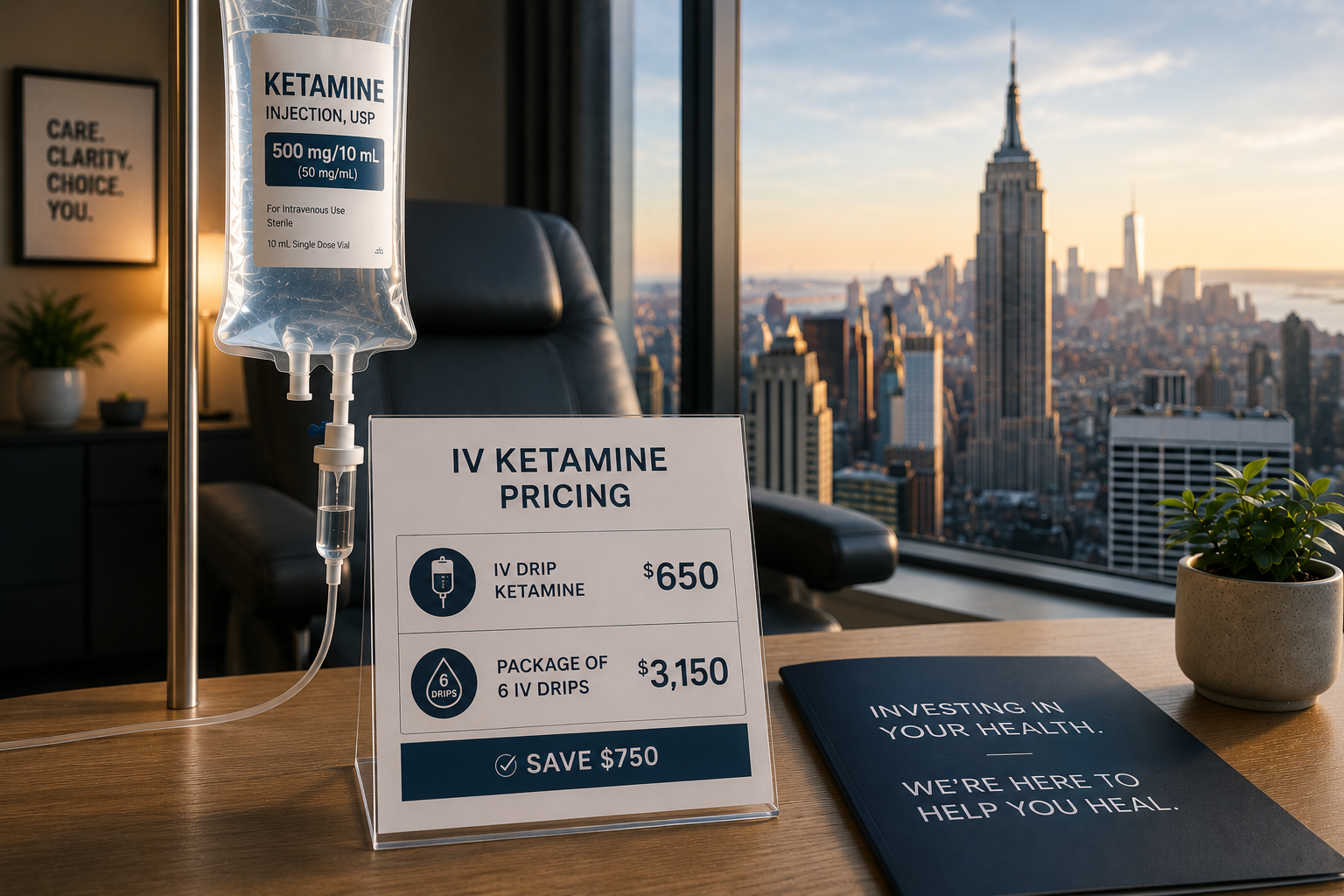
At Ketamine Wellness New York, our pricing is straightforward:
That is the entire fee structure. There are no facility charges, no observation fees, no monitoring add-ons, and no maintenance enrollment costs. When you complete a session, the transaction is finished.
For most patients, the standard initial course is a six-session induction protocol, typically completed over two to three weeks. After that, your physician will assess your response and discuss whether maintenance sessions are clinically warranted and at what frequency.
The total cost of an induction course at our clinic is $3,250. That is a significant sum, and we don’t pretend otherwise. What you get for it is faster access (typically within days of consultation rather than weeks of authorization), clinical protocol adjustments based on your actual response, no documentation requirements imposed by an insurer, and a direct relationship with your treating physician rather than care mediated by a payer.
For some patients, this is the right tradeoff. For others, the Spravato pathway with insurance coverage and manufacturer savings may still come out ahead on total cost. The honest answer depends on your specific plan, your specific diagnosis, and your specific clinical timeline.
Beyond IV ketamine and Spravato, a few other options are worth knowing about, especially if cash-pay isn’t workable for you right now.
Manufacturer savings programs for Spravato. If your Spravato appeal eventually succeeds, the SPRAVATO withMe Savings Program can reduce medication costs significantly for eligible commercially insured patients, sometimes to as little as $10 per treatment for the drug portion. This does not cover office visit or observation components, but it can meaningfully change the financial picture. Medicaid and Medicare patients are generally not eligible for these commercial savings programs.
A different treatment pathway entirely. A denial doesn’t always mean you’ve exhausted your options. Your psychiatrist may have other approaches worth discussing, including newer antidepressant classes, augmentation strategies, transcranial magnetic stimulation (TMS, which has broader insurance coverage), or intensive outpatient programs. None of these replace ketamine, but they may be reasonable interim steps.
Phased financial planning. If the full induction cost is the barrier, talk to your clinic about timing. Some patients begin with a single introductory session to assess response before committing to the full package. This isn’t a discount or a payment plan, but it can change how you stage the financial commitment.
If you’re trying to figure out concrete next steps, here is a practical sequence.
First, read the denial letter carefully and identify the exact reason given. Is it medical necessity, missing documentation, benefit exclusion, or a coding issue? The answer determines whether appealing is realistic.
Second, contact the clinic that submitted the original request. If they offer appeals support, ask them to walk through your options. If they don’t, ask whether they can refer you to a colleague who does, or whether your treating psychiatrist can take it on.
Third, if the denial is for IV ketamine specifically, recognize that appeals on this pathway rarely succeed. Spending weeks fighting a structural denial may delay treatment without changing the outcome. Consider whether your diagnosis qualifies for the Spravato pathway, or whether cash-pay IV ketamine fits your situation.
Fourth, if you want to explore cash-pay IV ketamine at our Jackson Heights, Queens or Great Neck, Long Island location, we are happy to walk through what treatment involves, what to expect, and whether it makes sense for your specific case. We won’t promise outcomes, and we won’t pretend our path is right for every patient. We will give you honest answers.
No. We do not submit Prior Authorization, prepare Letters of Medical Necessity, attend Peer-to-Peer reviews, or coordinate external appeals. If insurance appeals support is what you need, a Spravato provider or your treating psychiatrist’s office is a better starting point.
No. We provide IV ketamine infusion therapy only. Patients pursuing the insurance-covered Spravato pathway should look for a REMS-certified provider.
Usually not, but it depends. Most major insurers have policies classifying IV ketamine for psychiatric use as experimental, which means denials are structural rather than procedural. Appeals occasionally succeed, but the realistic odds are low. If your plan has unusually flexible out-of-network behavioral health benefits, it may be worth a conversation with your clinician.
Internal appeals for services not yet received are generally decided within 30 days. Internal appeals for services already received can take up to 60 days. External appeals through the New York Department of Financial Services are generally decided within 30 days for standard cases and 72 hours for expedited cases.
You can request a standard receipt for your session and submit it to your insurer if you wish. We do not prepare formal superbills, do not advise on coding, and do not follow up on reimbursement submissions. Reimbursement on out-of-network IV ketamine is uncertain in most plans.
A six-session induction package is $3,250. Standard single sessions are $650. An introductory session is $550. There are no additional facility, monitoring, or observation fees.
A ketamine denial is frustrating, especially when you’ve already worked hard to get this far. We want to be honest about what is and isn’t realistic from here.
If your denial is for Spravato and the issue is documentation, appealing is worth your effort. The clinic that submitted the original request is your best partner for that work, and New York’s external appeal rights give you meaningful protection if internal appeals fail.
If your denial is for IV ketamine and the issue is a structural policy exclusion, fighting the appeal is unlikely to change the outcome. Your time may be better spent evaluating alternative paths, including cash-pay IV ketamine, if that fits your situation, or a different treatment approach entirely.
Ketamine Wellness New York is one option among several. We are a cash-pay IV ketamine practice in Queens and Long Island, led by Dr. Pervaiz Qureshi, with transparent pricing and a clinical model built around flexibility. We don’t handle insurance appeals, and we won’t tell you that we do. If our model fits, we welcome the conversation. If it doesn’t, we hope this guide helped you figure out where to go next.

Standard treatments for alcohol use disorder help many people. But relapse rates remain high, and
Complex regional pain syndrome (CRPS), also known as reflex sympathetic dystrophy (RSD), sits among the

The infusion ends, the IV comes out, and you start to feel like yourself again.

Ketamine for Sleep: What New York Patients Should Know Poor sleep is exhausting in ways

Note: Names and identifying details have been changed to protect patient privacy. Stories reflect documented

Note: Names and identifying details have been changed to protect patient privacy. Stories reflect documented

The wait is the hardest part. Anxiety makes sleep impossible. Every stressor triggers a physical

Panic disorder does not just feel scary. It quietly reorganizes your entire life around avoidance.

You tried one medication, then another, and continued taking different antidepressants. No results? You adjusted

The room is dark. The blinds are shut. Even soft light sends pain radiating behind

The burning never fully stops. It’s there when you wake up, when you try to
The cost of a single IV ketamine infusion in 2026 typically falls between $400 and
You did the work. You spoke with your psychiatrist, gathered your medication history, submitted the
If you have an Aetna plan and you’re considering ketamine therapy for depression in New

Ketamine therapy, particularly in the form of intravenous (IV) infusions, has become a go-to treatment

Living in New York City often means paying a premium for everything, from rent to

For many individuals living with obsessive-compulsive disorder (OCD), the mind feels like a transmission with

Ketamine therapy is gaining popularity for its ability to alleviate severe depressive symptoms in hours

Finding affordable mental healthcare in New York can feel like navigating a maze, especially when

For many, therapy offers a vital path to healing and self-discovery. However, after years of
Thank you for choosing Wellness Clinic. Our specialist care team will contact you within the next 12 hours to confirm your appointment and answer any questions youmay have.
our team will review your message and contact your shortly. we look forward to supporting your wellness journey
Check your phone or email to receive your unique coupon code. You’ll need it when booking your first appointment.
 Optimized by Seraphinite Accelerator