

Life after service should not feel like staying on high alert. If you have served or work as a first responder, nightmares, intrusive memories, and broken sleep can make everyday routines difficult.
If treatment has not brought enough relief, you may be wondering whether ketamine for PTSD is worth a look. Promising headlines can raise hope, but conflicting claims make it hard to know what the evidence supports.
This guide puts the research and VA guidance into plain language. It covers established PTSD treatments, where ketamine may fit for co-occurring depression, and Long Island support resources.
Whether you are seeking care for yourself or supporting someone close, start with the facts below.
What PTSD Can Look Like After Service
The VA’s National Center for PTSD describes four types of symptoms that can follow a traumatic event. These can help you recognize what you are living with and when to reach out for support.
- Reliving the event: memories that feel very real, nightmares, flashbacks, or strong reactions to reminders.
- Avoidance: staying away from people, places, or situations that bring the event to mind.
- More negative thoughts and feelings: Feeling numb, losing interest in things you enjoyed, or carrying guilt or shame.
- Feeling on edge (hyperarousal): trouble sleeping or concentrating, being easily startled, irritability, anger, or unhealthy coping such as drinking more.
The VA recommends talking to a doctor or mental health provider if symptoms last longer than a month. You should also reach out if symptoms are very upsetting or disrupt your daily life.
PTSD is treatable, and for many people treatment can eliminate symptoms.
Start With The Treatments That Have The Strongest Evidence
Before you consider any new option, it helps to know what the evidence supports most strongly. The current VA and Department of Defense guideline offers a clear and practical starting point.
The 2023 VA/DoD clinical practice guideline recommends trauma-focused psychotherapy as the first-line treatment, ahead of medication. The VA names three therapies as most effective.
They are Cognitive Processing Therapy (CPT), Prolonged Exposure (PE), and Eye Movement Desensitization and Reprocessing (EMDR).
When therapy is not available or not preferred, the guideline strongly recommends three medications. The three are sertraline, paroxetine, and venlafaxine, and the FDA has approved the first two for PTSD.
If you have not tried one of these approaches with a trained clinician, that is the place to start. Your clinician can help match the approach to your symptoms and history.
If you have tried them and still struggle, you are not out of options. That is often where the ketamine question comes up.
Does The VA Recommend Ketamine For PTSD? What The Research Says
Ketamine is a real medicine with real research behind it, but the research for PTSD is still thin. Here is what the official guidance and the most rigorous trial so far say.
The 2023 VA/DoD clinical practice guideline suggests against using ketamine to treat PTSD, citing very low-quality evidence. The guideline recommends trauma-focused psychotherapy as the first-line treatment. VA guidance also notes ketamine or esketamine may be appropriate for co-occurring major depression that has not responded to medication.
Ketamine is approved by the FDA as an anesthetic, but it is not approved for PTSD or any psychiatric disorder. That means any use of ketamine for PTSD is off-label.
Feder et al. (2021), in the American Journal of Psychiatry, studied 30 adults with chronic PTSD. Each person received six IV infusions over two weeks of either ketamine or midazolam, an active comparison drug.
The ketamine group had a significantly greater reduction in PTSD severity at two weeks. But the study was small and stopped early after a planned interim analysis. Among people who responded, the benefit lasted a median of about four weeks after the infusions, so longer-term durability is unknown. The authors themselves called for further studies on this question.
Researchers have also registered trials of ketamine added to Prolonged Exposure therapy in veterans.
In plain terms, ketamine for PTSD alone is still an emerging, unproven option. Its stronger evidence base is in treatment-resistant depression, which can occur alongside PTSD.
We cover related questions in our post on medication-resistant PTSD and anxiety.
Where IV Ketamine May Fit: PTSD and Treatment-Resistant Depression
For some people, ketamine may become part of a broader plan under physician judgment. The clearest case is depression that has not improved, alongside PTSD, after adequate trials of standard treatment.
Ketamine has its strongest evidence in treatment-resistant depression, so this is the most reasonable use case. In that case, a physician may consider ketamine as one part of a plan centered on therapy. It is not a replacement for therapy, and it is not a first step.
Ketamine and trauma therapy are not interchangeable, and the research on combining them is still early. Some clinics offer ketamine-assisted psychotherapy, which pairs ketamine with therapy support.
A Common Scenario
A person completes a course of Cognitive Processing Therapy, and their nightmares ease. Depression stays heavy, though, even after two medication trials. They bring their full treatment history to a psychiatrist, who discusses a monitored ketamine series for the depression. Therapy continues, and both clinicians track PTSD and depression scores, so every change has context.
| Option | 2023 VA/DoD Guideline | How It Is Delivered |
|---|---|---|
| Trauma-focused psychotherapy (CPT, PE, EMDR) | Recommended first-line for PTSD | Weekly sessions with a trained therapist, through the VA, a Vet Center, or community providers |
| Sertraline, paroxetine, or venlafaxine | Strongly recommended for PTSD | Daily medication prescribed and monitored by a clinician |
| IV ketamine | Suggests against for PTSD (very low-quality evidence); may be considered for co-occurring treatment-resistant depression | Physician-supervised infusions in a clinic, off-label |
Takeaway: Therapy and approved medications lead for PTSD, and ketamine is a physician-led option for co-occurring treatment-resistant depression.
If you are considering ketamine, bring your full treatment history to your current clinician first. Our guide on how to talk to your doctor about ketamine can help you prepare.
You can also read about our approach in our detailed guides: ketamine treatment for PTSD and ketamine for trauma.
Long Island Resources For Veterans and First Responders
Strong support already exists close to home, and you do not need ketamine to access it. Each program below is described as its official page presents it, so you get accurate details.
The Northport VA Medical Center is at 79 Middleville Road in Northport. The VA says all its health care facilities offer same-day help for mental health concerns.
You can visit for mental health care with or without an appointment. You may qualify even if you are not enrolled in VA health care.
- Vet Center Long Island locations
The Nassau Vet Center is at 970 South Broadway in Hicksville. The Babylon Vet Center is at 100 West Main Street, 2nd Floor, in Babylon.
Vet Centers offer free, confidential counseling for eligible veterans and service members. Eligibility includes those who served in a combat theater or experienced military sexual trauma, plus some family members.
You do not need to enroll in VA health care to use a Vet Center. The Vet Center Call Center is open 24/7 at 877-927-8387.
The World Trade Center Health Program serves 9/11 responders and survivors. PTSD, depression, anxiety, and substance use disorder are covered conditions.
Members should not be billed for WTC-related services. Call 1-888-982-4748, Monday to Friday, 9 am to 5 pm ET.
- Your employer or union
Your employer or union may also offer employee assistance or peer support, so it is worth asking. For crisis lines, support groups, and county services across Nassau and Suffolk, see our Long Island mental health resources.
We are not affiliated with these programs, and details can change, so please confirm before you visit.
IV ketamine At Our Great Neck Clinic
Here is what we offer at our Great Neck clinic, and what we do not. We want you to have the facts before you call.
Ketamine Wellness NY provides physician-supervised IV ketamine at our Long Island clinic in Great Neck. The clinic is at 45 Middle Neck Road, Suite 220A.
Dr. Pervaiz Qureshi, MD, board-certified in internal medicine, leads care at our clinics. He has more than 30 years of clinical practice and completed his internal medicine residency at Brooklyn Hospital Center, and that background guides our screening.
That matters because your medications, blood pressure, and health history can all affect whether ketamine is safe for you.
Here is a summary of what to expect during an infusion:
- A clinical intake reviews your mental health history, medications, and goals.
- You receive a written treatment plan that includes coordination with your existing psychiatrist or therapist.
- Infusions usually last about 45 minutes, some up to an hour, with continuous nurse monitoring, followed by about 60 minutes of recovery.
- Plan on having someone drive you home afterward.
- How many infusions you need depends on you; some patients start with 2 to 3 infusions a week, then space them out as they improve.
- We accept cash payment, HSA, and FSA cards, and we do not bill insurance directly.
We do not provide psychotherapy, so we encourage you to continue trauma-focused therapy with your own clinician.
Frequently Asked Questions (FAQs)
Does the VA recommend ketamine for PTSD?
No, the 2023 VA/DoD guideline suggests against ketamine for PTSD, citing very low-quality evidence. It recommends trauma-focused psychotherapy first, with sertraline, paroxetine, or venlafaxine as medication options. VA guidance notes ketamine may be appropriate for co-occurring depression that has not responded to medication.
Can ketamine replace trauma therapy?
No, trauma-focused therapies such as CPT, PE, and EMDR have the strongest evidence for PTSD. Where ketamine is used, it is one part of a plan that keeps therapy at the center. That is usually for depression that has not responded to standard treatment.
Will ketamine bring up traumatic memories during an infusion?
We cannot predict how any one person will respond, because reactions to ketamine differ from person to person. A nurse monitors you throughout, and you can tell the team how you feel at any time. Share your trauma history at intake so your plan reflects it.
How much does IV ketamine cost, and are there veteran discounts?
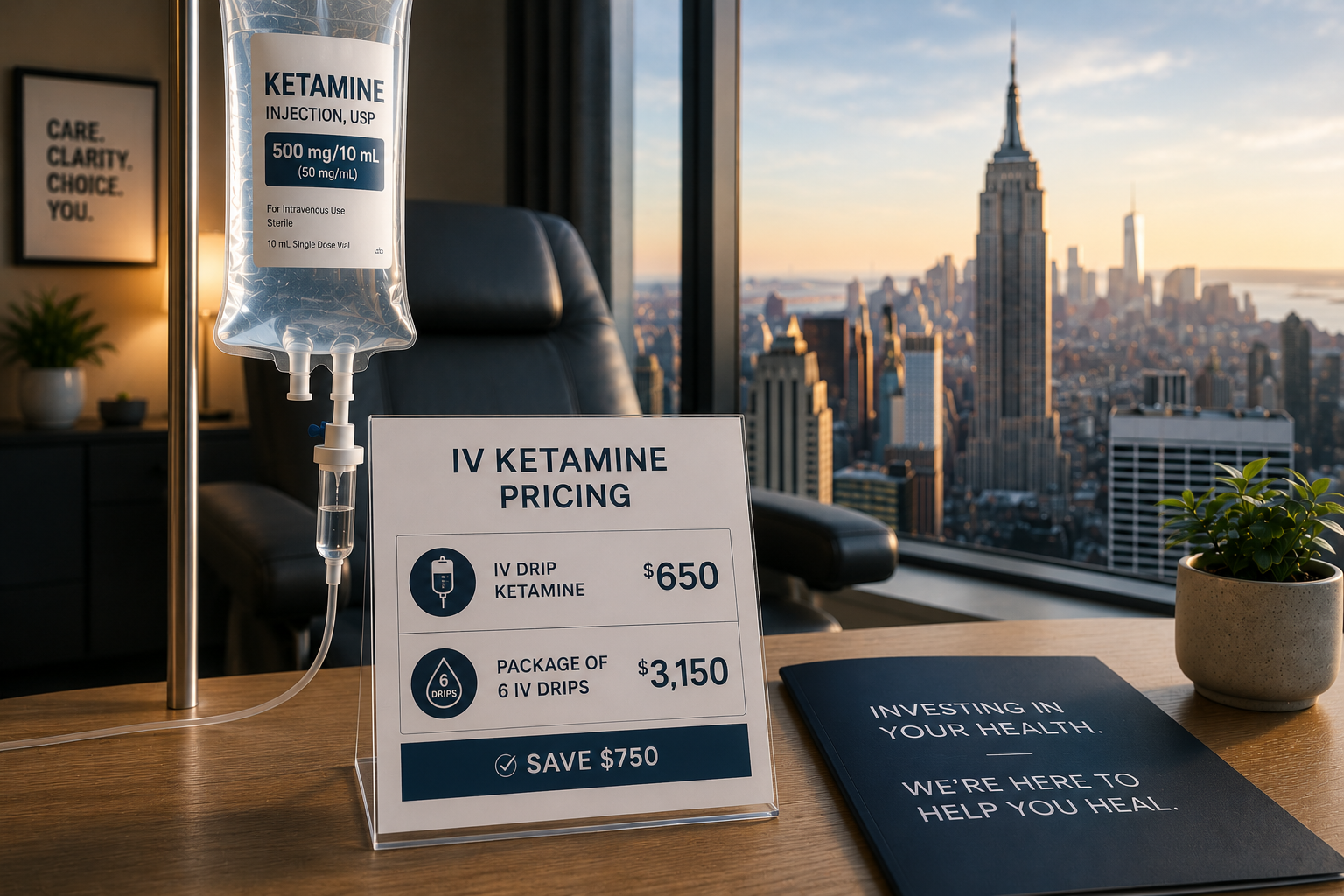
Ketamine Wellness NY is a cash-pay clinic that accepts HSA and FSA cards. You can find current rates on our pricing page, and they are the same for every patient. We do not offer veteran, first-responder, or occupational discounts. If you use VA care, ask your VA care team about your options first.
Where can 9/11 responders get PTSD care on Long Island?
The WTC Health Program covers PTSD and other mental health conditions for eligible responders and survivors. Members should not be billed for WTC-related services. Call 1-888-982-4748, Monday to Friday, 9 am to 5 pm ET, to ask about eligibility.
Where is Ketamine Wellness NY located?
Ketamine Wellness NY has two clinics, in Jackson Heights (Queens) and Great Neck (Long Island). The Great Neck clinic is at 45 Middle Neck Road, Suite 220A. You can call (516) 203-1041 to ask questions.
Final Thoughts
Ketamine for PTSD in veterans and first responders remains an open question, and honest answers matter more than big promises. Trauma-focused therapy still leads, and local VA and Vet Center support can start right away.
If depression has stayed after other treatments, ketamine may be worth discussing with your clinicians. Whatever you choose, you deserve clear facts, steady care, and a team that listens.
Take the time you need, and bring your questions to people you trust.
Take The Next Step At Your Pace
If you are already in trauma-focused care, or depression has not eased alongside PTSD, a conversation may help. You can call our Great Neck clinic at (516) 203-1041 or book a consultation to ask questions.
Please involve your VA or departmental clinician in any decision about ketamine. Our clinics are in Great Neck (Long Island) and Jackson Heights (Queens). We do not have a Manhattan location.
If you are in crisis, dial 988 and press 1 for the Veterans Crisis Line, or call or text 988.
Resources and References
- VA National Center for PTSD: PTSD Basics
https://www.ptsd.va.gov/understand/what/ptsd_basics.asp - A National Center for PTSD: Clinician's Guide to Medications for PTSD
https://www.ptsd.va.gov/professional/treat/txessentials/clinician_guide_meds.asp - FDA: Potential Risks Associated With Compounded Ketamine Products
https://web.archive.org/web/20260530025451/https://www.fda.gov/drugs/human-drug-compounding/fda-warns-patients-and-health-care-providers-about-potential-risks-associated-compounded-ketamine - Feder et al. (2021). A Randomized Controlled Trial of Repeated Ketamine Administration for Chronic Posttraumatic Stress Disorder
https://psychiatryonline.org/doi/10.1176/appi.ajp.2020.20050596 - Northport VA Medical Center
https://www.va.gov/northport-health-care/locations/northport-va-medical-center/ - Nassau Vet Center
https://www.va.gov/nassau-vet-center/ - Babylon Vet Center
https://www.va.gov/babylon-vet-center/ - Vet Center Call Center
https://www.vetcenter.va.gov/media/Call-Center-PSA.asp - CDC/NIOSH World Trade Center Health Program
https://www.cdc.gov/wtc/conditions.html