Skip to content
Written & Medically Reviewed by Dr. Pervaiz Qureshi, MD | Last Reviewed: July 6, 2026
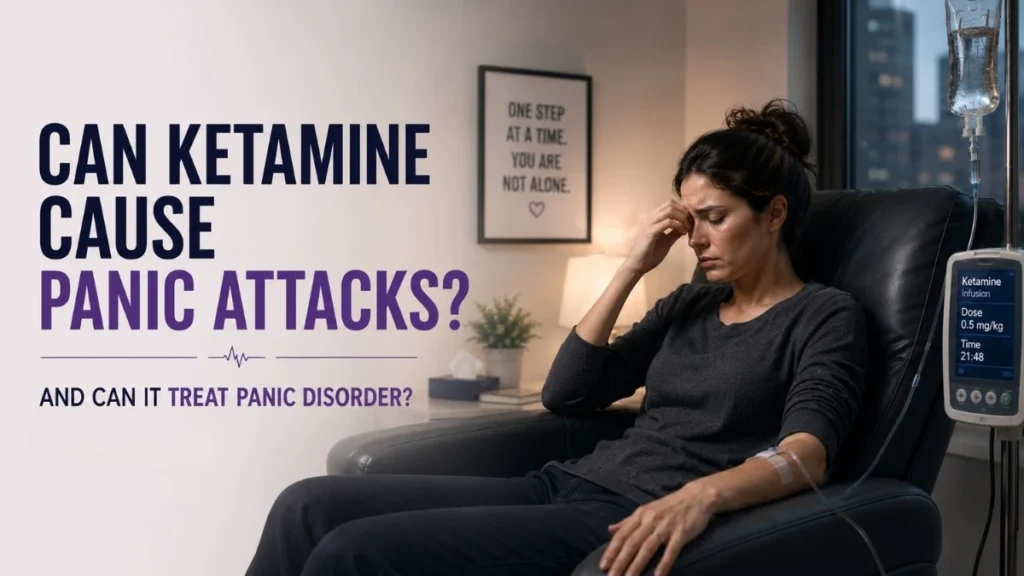
Ketamine can occasionally cause transient anxiety or, rarely, panic-attack-like feelings during the IV infusion itself. These effects typically resolve within minutes of stopping the infusion and fully remit within two hours.
Separately, published clinical research has documented cases where a single ketamine infusion resolved treatment-refractory panic disorder for weeks at a time.
Both are true. Which one applies depends on the patient, the dose, the clinical setting, and whether the panic-like feeling is a temporary side effect of the infusion or an underlying panic disorder ketamine is being used to treat.
So, can ketamine cause panic attacks? Rarely, and only under specific conditions. And can ketamine also treat them? In some patients, yes. In this article, we’ll cover both.
The short answer, in some patients, is yes, and the mechanism is specific. Ketamine’s dissociative effect during an infusion can feel like a panic attack. This is especially true for patients who have not experienced dissociation before.
Symptoms during an infusion can include racing heart, a feeling of unreality, difficulty focusing, and shortness of breath.
In a clinical setting, these are managed with grounding techniques and dose adjustment. In most patients, these sensations pass within minutes of stopping or slowing the infusion.
A study published in European Neuropsychopharmacology, found a correlation between in-session anxiety and lower antidepressant response rates. The panic-like response may itself be a clinical signal. It is not just an incidental side effect.
Understanding why ketamine causes anxiety starts with how the drug works in the brain. The mechanism that produces the therapeutic benefit is the same one that can feel unsettling to some patients.
Ketamine acts on NMDA receptors and modulates glutamate signaling. The same mechanism that drives the therapeutic effect also produces the dissociative feeling. That includes neuroplastic change and glutamate rebalancing.
For patients who have never experienced dissociation, the nervous system can interpret this unfamiliar internal state as danger. This can trigger symptoms that closely resemble a panic attack, including increased heart rate, breathlessness, and a sense of unreality.
This is a subjective response to an unfamiliar internal experience. It is not evidence that ketamine directly triggers panic disorder as a condition.
Higher doses and faster infusion rates significantly increase the chance of a panic-like response during ketamine. A clinical environment that feels cold or impersonal adds to that risk.
This is exactly why Ketamine Wellness NY physician-supervised IV protocols use a standard starting dose of 0.5 mg/kg over 40 minutes. Sessions take place in a calm, private treatment room. A clinical team is available to adjust the rate or dose in real time.
Setting is not a minor detail. It is a clinical variable that directly affects whether ketamine can make your anxiety worse during a session.
Patients with existing panic disorder, pre-treatment anxiety, or benzodiazepine dependence are at higher risk. Some patients with high sensitivity, dissociative states, or trauma triggers around loss-of-control experiences. All of these groups are more likely to feel panic during an infusion.
This is why thorough screening at the initial consultation matters. At Ketamine Wellness NY, these histories are flagged during the intake evaluation with Dr. Pervaiz Qureshi, MD, board-certified in internal medicine. Knowing your risk profile in advance lets the clinical team prepare accordingly.
This is where the clinical picture becomes more layered. Ketamine therapy for panic disorder is not just about managing in-session anxiety risk.
There is published evidence that ketamine can reduce panic disorder. In some patients, it has resolved it entirely, after every other treatment failed.
A 2016 case report in the Psychiatrist documented a 34-year-old woman with DSM-5 panic disorder, agoraphobia, and generalized anxiety disorder (GAD).
She had failed more than 30 sessions of CBT and prolonged exposure therapy. She had also failed ECT, escitalopram, lamotrigine, and lorazepam.
She received a single 0.5 mg/kg ketamine infusion, administered incidentally for pain in an emergency department. Her GAD-7 score dropped from 6 to 1 within a week. Her PHQ-9 dropped from 8 to 3.
She remained free of panic attacks for at least 10 weeks. She returned to driving, using public transit, and starting a business.
This is published, verifiable case data from the University of Utah’s Department of Psychiatry (Kious and Ray, Prim Care Companion CNS Disord, 2016).
A 2022 systematic review found that single-dose ketamine reduced panic symptoms, irritability, and generalized anxiety in patients with GAD and social anxiety disorder.
Higher doses were more effective at reducing symptom burden. Anxiety-reducing effects lasted up to two weeks in some patients.
The review supports the direction of the case study evidence. Ketamine can reduce panic in patients whose panic has not responded to conventional treatment.
The FDA has approved ketamine as anesthesia. It has also approved esketamine (Spravato) for treatment-resistant depression and MDD with suicidal ideation. Neither has been approved for panic disorder specifically.
Every clinic using ketamine for panic disorder, including Ketamine Wellness NY, does so off-label based on individual clinical evaluation. Off-label prescribing is legal and common in psychiatry.
This does mean that insurance typically does not cover ketamine therapy for panic disorder as a standalone indication. For a full breakdown, see the cost of ketamine therapy.
Ketamine Wellness NY uses a structured, multi-step approach to minimize the risk of panic during IV ketamine treatment. Every part of the process is designed around patient safety and comfort.
Pre-infusion screening covers current medications, panic history, and active benzodiazepine use. Patients with known risk factors receive a modified initial protocol.
The treatment room setup includes quiet, private spaces with dim, adjustable lighting. Music, weighted blankets, and verbal reassurance are available throughout the session. The clinical team is present for the full duration of every infusion.
Infusion adjustments are available at any point during the session. The rate can be slowed and the dose can be reduced in real time if the patient reports distress.
After the infusion ends, a post-infusion observation window of 20 to 30 minutes follows. The clinical team confirms the patient has returned to baseline before discharge.
For more detail on the full session process, see our IV ketamine treatment process.
A ketamine induced panic attack during a session is manageable. Knowing what to do in the moment makes a real difference.
During the infusion:
After leaving the clinic (rare):
Patients with treatment-refractory panic disorder are evaluated during the initial consultation with MD, Dr. Pervaiz Qureshi. He is board-certified in internal medicine, with clinical training spans Brooklyn Hospital, NYU, and Henry J. Carter Hospital.
The standard protocol at Ketamine Wellness NY is a six-session induction series over two to three weeks. Sessions are typically spaced one to two weeks apart. Maintenance sessions, if needed, follow at intervals of one to three months.
Dose and pacing are adjusted based on individual response. For patients with confirmed panic disorder or a history of benzodiazepine use, initial doses are reduced and session support is increased.
Our pricing is structured for accessibility:
You can also visit us at our Jackson Heights (Queens) clinic or our Great Neck (Long Island) clinic.
For a full overview of how we approach Ketamine for anxiety and panic disorders, or to start the process, book a consultation with Dr. Qureshi directly.
In some patients, ketamine’s dissociative effect during infusion can feel like a panic attack. This is more common in patients with existing panic disorder, benzodiazepine use, or sensitivity to loss-of-control experiences. In a supervised clinical setting, the response is managed by slowing or pausing the infusion, and it typically resolves within minutes.
Anxiety or panic-like feelings that occur during a ketamine infusion typically resolve within minutes of stopping or slowing the infusion. Full return to baseline usually happens within two hours. Effects lasting beyond the day of the session are rare and should be discussed with the clinical team.
Ketamine is not FDA-approved for panic disorder. However, published case reports and a 2022 systematic review have documented ketamine reducing panic symptoms in patients with treatment-refractory panic disorder, GAD, and social anxiety disorder. Effects can last from days to several weeks after a single dose. It is used off-label at Ketamine Wellness NY under physician evaluation.
Ketamine and benzodiazepines work on different systems. Ketamine acts on glutamate and NMDA receptors and does not carry the daily dependence risk of benzodiazepines. Ketamine is not a maintenance medication. Patients currently using benzodiazepines who begin ketamine therapy should not stop them abruptly. Any transition must be physician-supervised.
Tell the clinical team immediately. The infusion can be slowed or paused. Grounding techniques such as slow breathing, sensory counting, or verbal reassurance help you return to baseline. One panic response does not mean the treatment series should be stopped. Dose and pacing can be adjusted for the next session.
Not necessarily. Research from Aust et al. (2019) found a correlation between high in-session anxiety and reduced antidepressant response, though this is not true in every patient. This is one signal used to individualize treatment at Ketamine Wellness NY, not a definitive predictor. Response is tracked session by session.
Yes, but less commonly. Higher doses and faster infusion rates increase the risk significantly. The 0.5 mg/kg over 40 minutes protocol at Ketamine Wellness NY is designed to reduce the chance of a strong dissociative or panic response. It still delivers the therapeutic effect.
So, can ketamine cause panic attacks? Yes, in some patients, and the risk is real. But the clinical picture does not stop there.
The same drug that produces a transient panic-like feeling in one patient has, in published case studies, resolved treatment-resistant panic disorder in another. Both outcomes are documented.
The difference lies in screening, dosing, setting, and clinical oversight. At Ketamine Wellness NY, every one of those variables is managed before your first session begins.
1. Aust, S., et al. (2019). “Anxiety during Ketamine Infusions Is Associated with Negative Treatment Responses in Major Depressive Disorder.” European Neuropsychopharmacology
https://linkinghub.elsevier.com/retrieve/pii/S0924977X19301622
2. Brent M. Kious and Sheena M. Ray. (2016). “Sustained Resolution of Panic Disorder, Agoraphobia, and Generalized Anxiety Disorder With a Single Ketamine Infusion: A Case Report.” Psychiatrist
https://www.psychiatrist.com/pcc/resolution-of-panic-disorder-with-ketamine/
3. Jamie L. Tully, et al. (2022). “Ketamine treatment for refractory anxiety: A systematic review.” British Journal of Clinical Pharmacology
https://bpspubs.onlinelibrary.wiley.com/doi/10.1111/bcp.15374
Medical Disclaimer The information on this page is for educational purposes only and is not a substitute for professional medical advice, diagnosis, or treatment. If you have questions about ketamine therapy or panic disorder, speak with a qualified healthcare provider. The content here is based on peer-reviewed research, published case studies, and clinical guidelines, but individual outcomes vary. |
Thank you for choosing Wellness Clinic. Our specialist care team will contact you within the next 12 hours to confirm your appointment and answer any questions youmay have.
our team will review your message and contact your shortly. we look forward to supporting your wellness journey
Check your phone or email to receive your unique coupon code. You’ll need it when booking your first appointment.
 Optimized by Seraphinite Accelerator